Ch. 23 The Digestive System
Marieb - Human Anatomy & Physiology 7th Edition
Marieb, Hoehn7th EditionHuman Anatomy & PhysiologyISBN: 9780805359091Not the one you use?Change textbook
Chapter 22, Problem 11

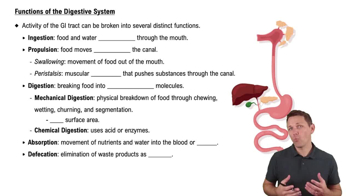
Name the six functional activities of the digestive system.

Verified step by step guidance
1
Understand that the digestive system performs several key functions to process food and absorb nutrients necessary for the body.
Identify the first functional activity: Ingestion, which is the process of taking food into the mouth.
Recognize the second activity: Propulsion, which includes swallowing and the movement of food through the digestive tract via peristalsis.
Note the third activity: Mechanical digestion, involving physical breakdown of food through chewing, churning, and segmentation.
List the remaining activities: Chemical digestion (breaking down food molecules by enzymes), Absorption (nutrients passing into the blood or lymph), and Defecation (elimination of indigestible substances as feces).

Verified video answer for a similar problem:

This video solution was recommended by our tutors as helpful for the problem above.
Video duration:
1m
Was this helpful?

Key Concepts

Here are the essential concepts you must grasp in order to answer the question correctly.

Ingestion

Ingestion is the process of taking food into the mouth, initiating digestion. It involves chewing and swallowing, which prepare food for further breakdown in the digestive tract.
Recommended video:
4:24
Pattern Recognition Receptors

Digestion

Digestion refers to the mechanical and chemical breakdown of food into smaller molecules. Mechanical digestion includes chewing and churning, while chemical digestion involves enzymes breaking down complex molecules.
Recommended video:
Guided course
5:08
Functions of the Digestive System

Absorption

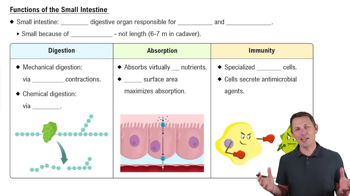
Absorption is the process by which nutrients from digested food pass through the lining of the intestines into the bloodstream. This allows the body to utilize essential nutrients for energy, growth, and repair.
Recommended video:
Guided course
3:44
Functions of the Small Intestine
Related Practice
Textbook Question

Trace the path of a single protein molecule that has been ingested.

The protein molecule will be digested by enzymes made by

a. The mouth, stomach, and colon

b. The stomach, liver, and small intestine

c. The small intestine, mouth, and liver

d. The pancreas, stomach, and small intestine

816
views
Textbook Question

Which of the following is not characteristic of the colon?

a. It is divided into ascending, transverse, and descending portions

b. It contains abundant bacteria, some of which synthesize certain vitamins

c. It is the main absorptive site

d. It absorbs much of the water and salts remaining in the wastes

146
views
Textbook Question

The sphincter between the stomach and duodenum is:

a. The pyloric sphincter

b. The gastroesophageal sphincter

c. The hepatopancreatic sphincter

d. The ileocecal valve

1204
views
Textbook Question

Someone has eaten a meal of buttered toast, cream, and eggs. Which of the following would you expect to happen?

a. Compared to the period shortly after the meal, gastric motility and secretion of HCl decrease when the food reaches the duodenum

b. Gastric motility increases even as the person is chewing the food (before swallowing)

c. Fat will be emulsified in the duodenum by the action of bile

d. All of these

765
views
Textbook Question

The gallbladder

a. Produces bile

b. Is attached to the pancreas

c. Stores and concentrates bile

d. Produces secretin

1103
views
Textbook Question

a. What is the normal number of permanent teeth? Of deciduous teeth?

b. What substance covers the tooth crown? Its root?

c. What substance makes up the bulk of a tooth?

d. What and where is pulp?

110
views