Ch 12: Rotation of a Rigid Body
Knight Calc - Physics for Scientists and Engineers 5th Edition
Knight Calc5th EditionPhysics for Scientists and EngineersISBN: 9780137344796Not the one you use?Change textbook
Chapter 12, Problem 17a

A 12-cm-diameter DVD has a mass of 21 g. What is the DVD’s moment of inertia for rotation about a perpendicular axis through its center?

Verified step by step guidance
1
Step 1: Identify the shape of the DVD. The DVD can be approximated as a uniform solid disk. The formula for the moment of inertia of a solid disk rotating about an axis perpendicular to its center is \( I = \frac{1}{2} m r^2 \), where \( m \) is the mass and \( r \) is the radius.
Step 2: Convert the given diameter of the DVD into its radius. The diameter is 12 cm, so the radius \( r \) is half of the diameter: \( r = \frac{12}{2} = 6 \, \text{cm} \). Convert this to meters: \( r = 0.06 \, \text{m} \).
Step 3: Convert the mass of the DVD from grams to kilograms. The mass is given as 21 g, and since \( 1 \, \text{kg} = 1000 \, \text{g} \), the mass in kilograms is \( m = \frac{21}{1000} = 0.021 \, \text{kg} \).
Step 4: Substitute the values of \( m \) and \( r \) into the formula for the moment of inertia: \( I = \frac{1}{2} m r^2 \). This becomes \( I = \frac{1}{2} \times 0.021 \times (0.06)^2 \).
Step 5: Perform the calculation to find the moment of inertia. Ensure that the units are consistent (mass in kilograms and radius in meters) and simplify the expression to obtain the final value of \( I \).

Verified video answer for a similar problem:

This video solution was recommended by our tutors as helpful for the problem above.
Video duration:
2m
Was this helpful?

Key Concepts

Here are the essential concepts you must grasp in order to answer the question correctly.

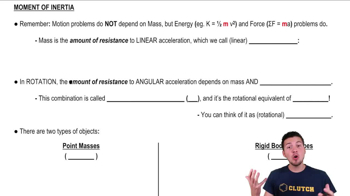
Moment of Inertia

Moment of inertia is a measure of an object's resistance to changes in its rotational motion. It depends on the mass distribution relative to the axis of rotation. For a solid disk, the moment of inertia can be calculated using the formula I = (1/2) m r², where m is the mass and r is the radius.
Recommended video:
Guided course
11:47
Intro to Moment of Inertia

Rotational Axis

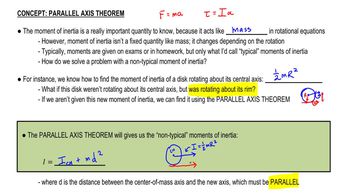
The rotational axis is the line about which an object rotates. In this case, the axis is perpendicular to the plane of the DVD and passes through its center. The choice of axis significantly affects the moment of inertia, as it determines how the mass is distributed relative to that axis.
Recommended video:
Guided course
13:46
Parallel Axis Theorem

Mass and Radius

The mass and radius of an object are critical parameters in calculating its moment of inertia. The mass (21 g) indicates how much matter is present, while the radius (6 cm, derived from the 12 cm diameter) affects how far the mass is distributed from the axis of rotation. Both factors are essential for determining the object's resistance to rotational acceleration.
Recommended video:
Guided course
06:18
Calculating Radius of Nitrogen