Ch 02: Kinematics in One Dimension
Knight Calc - Physics for Scientists and Engineers 5th Edition
Knight Calc5th EditionPhysics for Scientists and EngineersISBN: 9780137344796Not the one you use?Change textbook
Chapter 2, Problem 16

When you sneeze, the air in your lungs accelerates from rest to 150 km/h in approximately 0.50 s. What is the magnitude of the acceleration of the air in m/s2?

Verified step by step guidance
1
Convert the final velocity from km/h to m/s. Use the conversion factor: 1 km/h = 1000 m / 3600 s. Thus, \( v = 150 \; \text{km/h} \) can be converted to \( v = \frac{150 \times 1000}{3600} \; \text{m/s} \).
Identify the initial velocity \( u \) and the time \( t \). Here, \( u = 0 \; \text{m/s} \) (since the air starts from rest) and \( t = 0.50 \; \text{s} \).
Use the formula for acceleration: \( a = \frac{v - u}{t} \), where \( v \) is the final velocity, \( u \) is the initial velocity, and \( t \) is the time taken.
Substitute the known values into the formula: \( a = \frac{v - u}{t} = \frac{v - 0}{0.50} \).
Simplify the expression to find the magnitude of the acceleration in \( \text{m/s}^2 \).

Verified video answer for a similar problem:

This video solution was recommended by our tutors as helpful for the problem above.
Video duration:
5m
Was this helpful?

Key Concepts

Here are the essential concepts you must grasp in order to answer the question correctly.

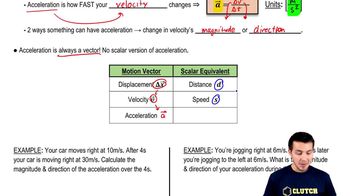
Acceleration

Acceleration is defined as the rate of change of velocity over time. It is a vector quantity, meaning it has both magnitude and direction. In this context, it can be calculated using the formula a = (final velocity - initial velocity) / time. Here, the initial velocity is 0 m/s, and the final velocity is 150 km/h, which must be converted to meters per second for the calculation.
Recommended video:
Guided course
05:47
Intro to Acceleration

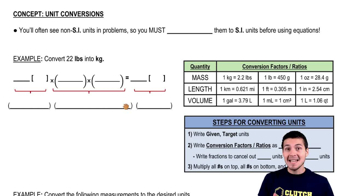
Unit Conversion

Unit conversion is the process of converting a quantity expressed in one set of units to another. In this problem, the final velocity of 150 km/h needs to be converted to meters per second (m/s) for consistency with the acceleration formula. The conversion factor is 1 km/h = 1/3.6 m/s, which allows for accurate calculations in the SI unit system.
Recommended video:
Guided course
07:46
Unit Conversions

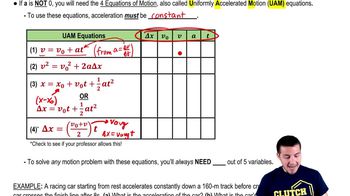
Kinematics

Kinematics is the branch of mechanics that deals with the motion of objects without considering the forces that cause the motion. It involves concepts such as displacement, velocity, and acceleration. In this scenario, kinematic equations can be applied to determine the acceleration of the air as it moves from rest to a specified velocity over a given time interval.
Recommended video:
Guided course
08:25
Kinematics Equations