Ch 04: Kinematics in Two Dimensions
Knight Calc - Physics for Scientists and Engineers 5th Edition
Knight Calc5th EditionPhysics for Scientists and EngineersISBN: 9780137344796Not the one you use?Change textbook
Chapter 4, Problem 7

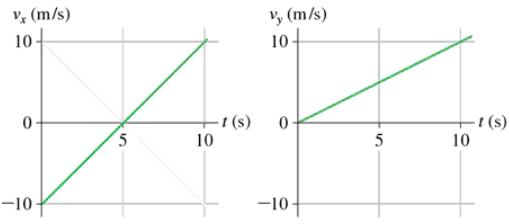
A rocket-powered hockey puck moves on a horizontal frictionless table. Figure EX4.7 shows graphs of vx and vy the x- and y-components of the puck's velocity. The puck starts at the origin. What is the magnitude of the puck's acceleration at t = 5s?

Verified step by step guidance
1
Step 1: Analyze the graph of the x-component of velocity (vx). The graph shows a linear relationship between vx and time (t), indicating constant acceleration in the x-direction. The slope of the graph represents the acceleration in the x-direction.
Step 2: Calculate the slope of the vx graph to determine the x-component of acceleration (ax). Use the formula for slope: ax = (change in vx) / (change in t). From the graph, select two points, such as (t = 0, vx = -8 m/s) and (t = 20 s, vx = 12 m/s).
Step 3: Analyze the y-component of velocity (vy). Since the graph for vy is not provided, assume vy is constant or zero unless otherwise stated. If vy is constant, the y-component of acceleration (ay) is zero.
Step 4: Combine the x- and y-components of acceleration to find the magnitude of the total acceleration. Use the formula: a = sqrt(ax^2 + ay^2). Substitute ax from Step 2 and ay from Step 3.
Step 5: Evaluate the magnitude of acceleration at t = 5 s using the calculated values of ax and ay. Since acceleration is constant, the magnitude will be the same at any time.

Verified video answer for a similar problem:

This video solution was recommended by our tutors as helpful for the problem above.
Video duration:
9m
Was this helpful?

Key Concepts

Here are the essential concepts you must grasp in order to answer the question correctly.

Velocity Components

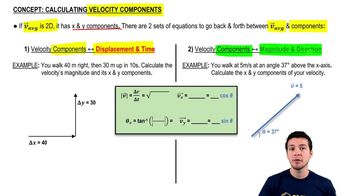
In physics, velocity can be broken down into its components along different axes, typically x and y. For a moving object, the x-component represents motion along the horizontal axis, while the y-component represents motion along the vertical axis. Understanding these components is crucial for analyzing the object's overall motion and determining its acceleration.
Recommended video:
Guided course
05:53
Calculating Velocity Components

Acceleration

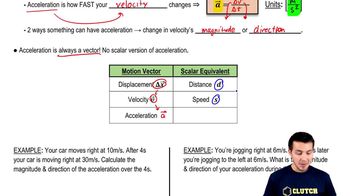
Acceleration is defined as the rate of change of velocity over time. It is a vector quantity, meaning it has both magnitude and direction. In this scenario, to find the puck's acceleration, one must analyze the change in its velocity components over the specified time interval, which can be derived from the velocity graphs provided.
Recommended video:
Guided course
05:47
Intro to Acceleration

Graph Interpretation

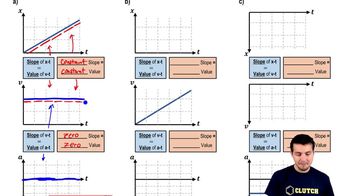
Interpreting graphs is essential in physics for extracting information about motion. The slope of a velocity vs. time graph indicates acceleration; a constant slope signifies constant acceleration. By examining the graph of the x-component of velocity, one can determine the acceleration at any given time, including at t = 5s, by calculating the slope of the line.
Recommended video:
Guided course
07:32
Graphing Position, Velocity, and Acceleration Graphs
Related Practice
Textbook Question

A particle's trajectory is described by x=(12t32t2)mandy=(12t22t)m,x = \(\left\)(\(\frac{1}{2}\) t^3 - 2t^2\(\right\)) \, \(\text{m}\) \(\quad\) \(\text{and}\) \(\quad\) y = \(\left\)(\(\frac{1}{2}\) t^2 - 2t\(\right\)) \, \(\text{m}\), where tt is in ss. What are the particle's position and speed at t=0 st=0\(\text{ s}\) and t=4 st=4\(\text{ s}\)?

2966
views
1
rank
Textbook Question

A particle's trajectory is described by x=(12t32t2)mandy=(12t22t)m,x = \(\left\)(\(\frac{1}{2}\) t^3 - 2t^2\(\right\)) \, \(\text{m}\) \(\quad\) \(\text{and}\) \(\quad\) y = \(\left\)(\(\frac{1}{2}\) t^2 - 2t\(\right\)) \, \(\text{m}\), where tt is in ss. What is the particle's direction of motion, measured as an angle from the xx-axis, at t=0 st=0\(\text{ s}\) and t=4 st=4\(\text{ s}\)?

403
views
Textbook Question

A rocket-powered hockey puck moves on a horizontal frictionless table. FIGURE EX4.6 shows graphs of vx and vy, the x- and y-components of the puck's velocity. The puck starts at the origin. How far from the origin is the puck at t = 5s?

2158
views
Textbook Question

A particle moving in the xy-plane has velocity v = (2ti + (3-t2)j) m/s, where t is in s. What is the particle's acceleration vector at t = 4s?

4152
views
Textbook Question

Is this particle curving upward, curving downward, or moving in a straight line?

1792
views
1
rank
Textbook Question

A rocket-powered hockey puck moves on a horizontal frictionless table. FIGURE EX4.6 shows graphs of vx and vy, the x- and y-components of the puck's velocity. The puck starts at the origin. In which direction is the puck moving at t = 2s? Give your answer as an angle from the x-axis.

2274
views
1
rank