Ch 02: Kinematics in One Dimension
Knight Calc - Physics for Scientists and Engineers 5th Edition
Knight Calc5th EditionPhysics for Scientists and EngineersISBN: 9780137344796Not the one you use?Change textbook
Chapter 2, Problem 12b

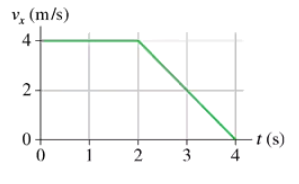
FIGURE EX2.12 shows the velocity-versus-time graph for a particle moving along the x-axis. Its initial position is at x0 = 2 m at t0 = 0 s. What are the particle's position, velocity, and acceleration at t = 3.0 s?

Verified step by step guidance
1
Step 1: Analyze the velocity-versus-time graph provided. From t = 0s to t = 20s, the velocity is constant at 3 m/s. From t = 20s to t = 50s, the velocity increases linearly from 3 m/s to 5 m/s, indicating a constant acceleration during this interval.
Step 2: Determine the velocity of the particle at t = 3.0s. Since t = 3.0s falls within the interval where the velocity is constant (0s to 20s), the velocity at t = 3.0s is 3 m/s.
Step 3: Calculate the position of the particle at t = 3.0s using the formula for position under constant velocity: \( x = x_0 + v_x \cdot t \). Here, \( x_0 = 2 \, \text{m} \), \( v_x = 3 \, \text{m/s} \), and \( t = 3.0 \, \text{s} \). Substitute these values into the formula.
Step 4: Determine the acceleration of the particle at t = 3.0s. Since the velocity is constant during the interval from t = 0s to t = 20s, the acceleration is zero (\( a = \frac{\Delta v}{\Delta t} \) where \( \Delta v = 0 \) for constant velocity).
Step 5: Summarize the results. At t = 3.0s, the particle's position can be calculated using the formula in Step 3, its velocity is 3 m/s (from the graph), and its acceleration is 0 m/s² (constant velocity implies no acceleration).

Verified video answer for a similar problem:

This video solution was recommended by our tutors as helpful for the problem above.
Video duration:
11m
Was this helpful?

Key Concepts

Here are the essential concepts you must grasp in order to answer the question correctly.

Velocity

Velocity is a vector quantity that describes the rate of change of an object's position with respect to time. It has both magnitude and direction, and in this context, it is represented on the y-axis of the velocity-time graph. The slope of the graph indicates the object's speed, while the value of velocity at a specific time gives the speed and direction of the particle's motion.
Recommended video:
Guided course
7:27
Escape Velocity

Acceleration

Acceleration is the rate of change of velocity over time. It can be calculated from the slope of the velocity-time graph. If the velocity is constant, as seen in the initial part of the graph, the acceleration is zero. However, if the velocity changes, the slope will indicate the magnitude and direction of the acceleration, which is crucial for understanding how the particle's motion evolves over time.
Recommended video:
Guided course
05:47
Intro to Acceleration

Position

Position refers to the location of an object at a specific time, typically measured from a reference point. In this scenario, the initial position of the particle is given as x0 = 2m at t0 = 0s. To find the position at t = 3.0s, one must integrate the velocity over time, taking into account any changes in velocity and the initial position to determine the particle's location along the x-axis.
Recommended video:
Guided course
14:03
Rotational Position & Displacement