
Textbook Question
A 1.0 kg mass that can move along the x-axis experiences the potential energy U = (x²−x) J, where x is in m. The mass has velocity vx = 3.0 m/s at position x = 1.0 m. At what position has it slowed to 1.0 m/s?
1768
views

 Verified step by step guidance
 06:43
06:43
 06:35
06:35 04:10
04:10A 1.0 kg mass that can move along the x-axis experiences the potential energy U = (x²−x) J, where x is in m. The mass has velocity vx = 3.0 m/s at position x = 1.0 m. At what position has it slowed to 1.0 m/s?
A system has potential energy as a particle moves over the range . For each, is it a point of stable or unstable equilibrium?
A particle that can move along the x-axis is part of a system with potential energy U(x) = A/x2 − B/x where A and B are positive constants. Where are the particle's equilibrium positions?
CALC A 2.6 kg block is attached to a horizontal rope that exerts a variable force Fx = (20 − 5x) N, where x is in m. The coefficient of kinetic friction between the block and the floor is 0.25. Initially the block is at rest at x = 0 m. What is the block's speed when it has been pulled to x = 4.0 m?
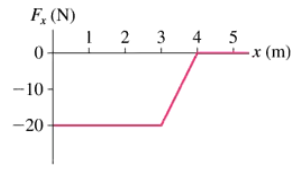
A 100 g particle experiences the one-dimensional, conservative force Fx shown in FIGURE P10.60. Suppose the particle is shot to the right from x = 1.0 m with a speed of 25 m/s. Where is its turning point?
A clever engineer designs a 'sprong' that obeys the force law Fx=−q(x−xeq)³ , where xeq is the equilibrium position of the end of the sprong and q is the sprong constant. For simplicity, we'll let xeq = 0 m .Then Fx = −qx³. Find an expression for the potential energy of a stretched or compressed sprong.