

Ch 12: Rotation of a Rigid Body
Knight Calc - Physics for Scientists and Engineers 5th Edition
Knight Calc5th EditionPhysics for Scientists and EngineersISBN: 9780137344796Not the one you use?Change textbook
Chapter 12, Problem 85

Objects that rotate in air or water experience a torque due to drag. With quadratic drag, a drag torque that's negligible at low rpm quickly becomes significant as the rpm increases. Consider a square bar with cross section a x a and length L. It is rotating on an axle through its center at angular velocity ω in a fluid of density ρ. Assume that the drag coefficient C𝒹 is constant along the length of the bar. Find an expression for the magnitude of the drag torque on the bar. Hint: Begin by considering the drag force on a small piece of the bar of length dr at distance r from the axle.

Verified step by step guidance
1
Step 1: Begin by considering the drag force on a small piece of the bar. The drag force on a small segment of length dr at a distance r from the axle is proportional to the square of the tangential velocity of the segment. The tangential velocity is given by v = ωr, where ω is the angular velocity and r is the distance from the axle.
Step 2: The drag force on the small segment can be expressed as dF = (1/2) * C𝒹 * p * A * v², where C𝒹 is the drag coefficient, p is the fluid density, A is the cross-sectional area of the bar (a² for a square cross-section), and v² = (ωr)². Substitute v² into the equation to get dF = (1/2) * C𝒹 * p * a² * (ωr)².
Step 3: The torque due to this drag force on the small segment is given by dτ = r * dF, where r is the distance from the axle. Substitute dF into this equation to get dτ = r * (1/2) * C𝒹 * p * a² * (ωr)² = (1/2) * C𝒹 * p * a² * ω² * r³ * dr.
Step 4: To find the total drag torque on the bar, integrate dτ over the length of the bar. The limits of integration for r are from 0 to L/2, since the bar extends symmetrically on both sides of the axle. The total drag torque is τ = ∫[(1/2) * C𝒹 * p * a² * ω² * r³] dr, with limits 0 to L/2.
Step 5: Perform the integration. The integral of r³ with respect to r is (r⁴)/4. Substitute the limits of integration (0 to L/2) into the result to find the expression for the total drag torque. The final expression will be τ = (1/2) * C𝒹 * p * a² * ω² * [(L/2)⁴ / 4].

Verified video answer for a similar problem:

This video solution was recommended by our tutors as helpful for the problem above.
Video duration:
8m
Was this helpful?

Key Concepts

Here are the essential concepts you must grasp in order to answer the question correctly.

Torque

Torque is a measure of the rotational force applied to an object, causing it to rotate about an axis. It is calculated as the product of the force applied and the distance from the axis of rotation to the point where the force is applied. In the context of rotating objects, torque is crucial for understanding how forces, such as drag, affect the motion and stability of the object.
Recommended video:
Guided course
08:55
Net Torque & Sign of Torque

Drag Force

Drag force is the resistance experienced by an object moving through a fluid, such as air or water. It is influenced by factors like the object's shape, size, and speed, as well as the fluid's density and viscosity. For rotating objects, the drag force can vary with the square of the velocity, leading to significant effects on torque at higher rotational speeds.
Recommended video:
Guided course
06:48
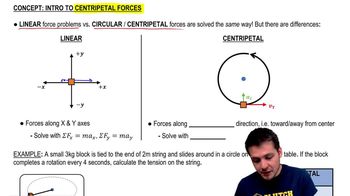
Intro to Centripetal Forces

Quadratic Drag

Quadratic drag refers to the drag force that increases with the square of the velocity of the object moving through a fluid. This relationship becomes particularly important at higher speeds, where the drag force can significantly impact the motion of the object. Understanding quadratic drag is essential for calculating the drag torque on rotating objects, as it dictates how the drag force scales with angular velocity.
Recommended video:
Guided course
5:13
Quadratic Equations
Related Practice
Textbook Question

The two blocks in FIGURE CP12.86 are connected by a massless rope that passes over a pulley. The pulley is 12 cm in diameter and has a mass of 2.0 kg. As the pulley turns, friction at the axle exerts a torque of magnitude 0.50 N m. If the blocks are released from rest, how long does it take the 4.0 kg block to reach the floor?

1930
views
3
rank
Textbook Question

A rod of length L and mass M has a nonuniform mass distribution. The linear mass density (mass per length) is λ = cx2, where x is measured from the center of the rod and c is a constant. Find an expression for c in terms of L and M.

1794
views
Textbook Question

A merry-go-round is a common piece of playground equipment. A 3.0-m-diameter merry-go-round with a mass of 250 kg is spinning at 20 rpm. John runs tangent to the merry-go-round at 5.0 m/s, in the same direction that it is turning, and jumps onto the outer edge. John's mass is 30 kg. What is the merry-go-round's angular velocity, in rpm, after John jumps on?

2709
views
Textbook Question

A rod of length L and mass M has a nonuniform mass distribution. The linear mass density (mass per length) is λ = cx2 , where x is measured from the center of the rod and c is a constant. Find an expression in terms of L and M for the moment of inertia of the rod for rotation about an axis through the center.

1586
views
Textbook Question

During most of its lifetime, a star maintains an equilibrium size in which the inward force of gravity on each atom is balanced by an outward pressure force due to the heat of the nuclear reactions in the core. But after all the hydrogen 'fuel' is consumed by nuclear fusion, the pressure force drops and the star undergoes a gravitational collapse until it becomes a neutron star. In a neutron star, the electrons and protons of the atoms are squeezed together by gravity until they fuse into neutrons. Neutron stars spin very rapidly and emit intense pulses of radio and light waves, one pulse per rotation. These 'pulsing stars' were discovered in the 1960s and are called pulsars. a. A star with the mass (M = 2.0 X 1030 kg) and size (R = 7.0 x 10⁸ m) of our sun rotates once every 30 days. After undergoing gravitational collapse, the star forms a pulsar that is observed by astronomers to emit radio pulses every 0.10 s. By treating the neutron star as a solid sphere, deduce its radius.

1500
views
Textbook Question

FIGURE P12.82 shows a cube of mass m sliding without friction at speed v0. It undergoes a perfectly elastic collision with the bottom tip of a rod of length d and mass M = 2m. The rod is pivoted about a frictionless axle through its center, and initially it hangs straight down and is at rest. What is the cube's velocity—both speed and direction—after the collision?

1432
views