Ch 14: Fluids and Elasticity
Knight Calc - Physics for Scientists and Engineers 5th Edition
Knight Calc5th EditionPhysics for Scientists and EngineersISBN: 9780137344796Not the one you use?Change textbook
Chapter 14, Problem 43b

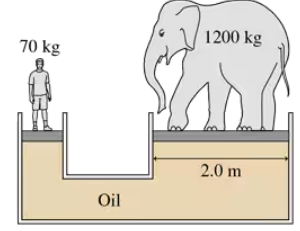
When a second student joins the first, the piston sinks. What is the second student's mass?

Verified step by step guidance
1
Step 1: Understand the problem setup. The system involves a hydraulic lift with an incompressible fluid. The car is on one side of the piston, and the students are on the other side. The mass of the car is 1450 kg, and the mass of the first student is 85 kg. We need to find the mass of the second student when the piston sinks due to their combined weight.
Step 2: Recall Pascal's principle, which states that pressure is transmitted equally throughout the incompressible fluid. The pressure exerted by the car on one side of the piston must equal the pressure exerted by the students on the other side.
Step 3: Write the pressure equation. Pressure is defined as force divided by area: \( P = \frac{F}{A} \). The force exerted by the car is \( F_{car} = m_{car} \cdot g \), and the force exerted by the students is \( F_{students} = (m_{student1} + m_{student2}) \cdot g \). The areas of the pistons are proportional to their diameters.
Step 4: Set up the equality of pressures: \( \frac{F_{car}}{A_{car}} = \frac{F_{students}}{A_{students}} \). Substitute \( F_{car} = m_{car} \cdot g \) and \( F_{students} = (m_{student1} + m_{student2}) \cdot g \). The gravitational acceleration \( g \) cancels out, leaving \( \frac{m_{car}}{A_{car}} = \frac{m_{student1} + m_{student2}}{A_{students}} \).
Step 5: Solve for \( m_{student2} \). The areas \( A \) are proportional to the square of the diameters of the pistons. Use the given dimensions to calculate the ratio of the areas, and rearrange the equation to isolate \( m_{student2} \): \( m_{student2} = \frac{m_{car} \cdot A_{students}}{A_{car}} - m_{student1} \). Substitute the known values to find the mass of the second student.

Verified video answer for a similar problem:

This video solution was recommended by our tutors as helpful for the problem above.
Video duration:
11m
Was this helpful?

Key Concepts

Here are the essential concepts you must grasp in order to answer the question correctly.

Buoyancy

Buoyancy is the upward force exerted by a fluid that opposes the weight of an object immersed in it. This principle, described by Archimedes, states that the buoyant force on an object is equal to the weight of the fluid displaced by the object. In this scenario, the piston sinks due to the combined weight of the car and the second student, which affects the fluid displacement.
Recommended video:
Guided course
11:06
Intro to Buoyancy & Buoyant Force

Weight and Mass

Weight is the force exerted by gravity on an object, calculated as the product of mass and gravitational acceleration (W = mg). In this context, the mass of the second student contributes to the total weight acting on the piston, influencing how much the piston sinks into the incompressible fluid. Understanding the relationship between mass and weight is crucial for solving the problem.
Recommended video:
Guided course
10:19
Torque Due to Weight

Incompressible Fluid

An incompressible fluid is one that does not change in volume when subjected to pressure. In this problem, the fluid's incompressibility means that any additional weight (from the second student) will directly affect the fluid's pressure and the buoyant force acting on the piston. This concept is essential for analyzing how the system behaves when the second student joins the first.
Recommended video:
Guided course
03:41
Ideal vs Real Fluids
Related Practice
Textbook Question

An aquarium of length L, width (front to back) W, and depth D is filled to the top with liquid of density ρ. Find an expression for the force of the liquid on the front window of the aquarium.

2275
views

Textbook Question

A 5.0-m-diameter solid aluminum sphere is launched into space. By how much does its diameter increase? Give your answer in μm.

2074
views
Textbook Question

Glycerin is poured into an open U-shaped tube until the height in both sides is 20 cm. Ethyl alcohol is then poured into one arm until the height of the alcohol column is 20 cm. The two liquids do not mix. What is the difference in height between the top surface of the glycerin and the top surface of the alcohol?

2893
views
Textbook Question

A friend asks you how much pressure is in your car tires. You know that the tire manufacturer recommends 30 psi, but it's been a while since you've checked. You can't find a tire gauge in the car, but you do find the owner's manual and a ruler. Fortunately, you've just finished taking physics, so you tell your friend, 'I don't know, but I can figure it out.' From the owner's manual you find that the car's mass is 1500 kg. It seems reasonable to assume that each tire supports one-fourth of the weight. With the ruler you find that the tires are 15 cm wide and the flattened segment of the tire in contact with the road is 13 cm long. What answer—in psi—will you give your friend?

2232
views
Textbook Question

An unknown liquid flows smoothly through a 6.0-mm-diameter horizontal tube where the pressure gradient is 600 Pa/m. Then the tube diameter gradually shrinks to 3.0 mm. What is the pressure gradient in this narrower portion of the tube?

1875
views
Textbook Question

A 55 kg cheerleader uses an oil-filled hydraulic lift to hold four 110 kg football players at a height of 1.0 m. If her piston is 16 cm in diameter, what is the diameter of the football players' piston?

1755
views
1
rank