
Ch 25: The Electric Potential
Knight Calc - Physics for Scientists and Engineers 5th Edition
Knight Calc5th EditionPhysics for Scientists and EngineersISBN: 9780137344796Not the one you use?Change textbook
Chapter 25, Problem 66b

A Van de Graaff generator is a device for generating a large electric potential by building up charge on a hollow metal sphere. A typical classroom-demonstration model has a diameter of 30 cm. What is the electric field strength just outside the surface of the sphere when it is charged to 500,000 V?

Verified step by step guidance
1
Step 1: Understand the relationship between electric potential (V), electric field (E), and the radius (r) of the sphere. For a charged sphere, the electric field just outside the surface is given by the formula: E = Vr, where V is the electric potential and r is the radius of the sphere.
Step 2: Convert the diameter of the sphere to its radius. The diameter is given as 30 cm, so the radius is half of that: r = 302 = 15 cm. Convert this to meters since SI units are required: r = 0.15 m.
Step 3: Substitute the given values into the formula for the electric field. The electric potential is V = 500,000 V, and the radius is r = 0.15 m. The formula becomes: E = 500,0000.15.
Step 4: Simplify the expression to calculate the electric field strength. Perform the division to find the value of E in units of volts per meter (V/m).
Step 5: Verify the units and ensure the result is reasonable. The electric field strength should be expressed in V/m, and the magnitude should align with the expected range for a Van de Graaff generator.

Verified video answer for a similar problem:

This video solution was recommended by our tutors as helpful for the problem above.
Video duration:
7m
Was this helpful?

Key Concepts

Here are the essential concepts you must grasp in order to answer the question correctly.

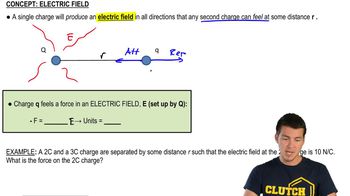
Electric Field

The electric field is a vector field that represents the force exerted by an electric charge on other charges in its vicinity. It is defined as the force per unit charge and is measured in volts per meter (V/m). The strength of the electric field just outside a charged conductor can be calculated using the formula E = V/d, where V is the electric potential and d is the distance from the surface.
Recommended video:
Guided course
03:16
Intro to Electric Fields

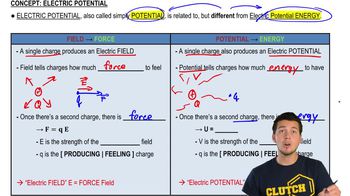
Electric Potential

Electric potential, measured in volts (V), is the amount of electric potential energy per unit charge at a point in an electric field. It indicates how much work would be done to move a charge from a reference point to a specific point in the field. In the context of the Van de Graaff generator, a potential of 500,000 V means that a charge would gain significant energy when moved to the surface of the sphere.
Recommended video:
Guided course
07:33
Electric Potential

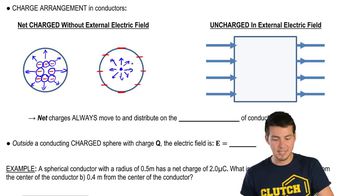
Conductors and Charge Distribution

Conductors allow electric charges to move freely, leading to a uniform distribution of charge on their surfaces when in electrostatic equilibrium. For a spherical conductor, the charge resides entirely on the surface, and the electric field outside the sphere can be treated as if all the charge were concentrated at the center. This principle simplifies calculations of electric fields around charged conductors.
Recommended video:
Guided course
07:43
Electric Fields in Conductors
Related Practice
Textbook Question

Two metal objects that are in contact must be at the same potential, an assertion we'll prove in the next chapter. Suppose a metal sphere of radius R is charged to 1000 V and a second metal sphere of radius 2R is charged to 2000 V. The two spheres are brought into contact and then separated. Afterward, what is the potential of each sphere?

229
views
Textbook Question

Two spherical drops of mercury each have a charge of 0.10 nC and a potential of 300 V at the surface. The two drops merge to form a single drop. What is the potential at the surface of the new drop?

132
views
Textbook Question

Electrodes of area A are spaced distance d apart to form a parallel-plate capacitor. The electrodes are charged to ±q. What is the infinitesimal increase in electric potential energy dU if an infinitesimal amount of charge dq is moved from the negative electrode to the positive electrode?

141
views
Textbook Question

FIGURE P25.67 shows two uniformly charged spheres. What is the potential difference between points 1 and 2? Which point is at the higher potential? Hint: The potential at any point is the superposition of the potentials due to all charges.

172
views
Textbook Question

FIGURE P25.70 shows a thin rod of length L and charge Q. Find an expression for the electric potential a distance x away from the center of the rod on the axis of the rod.

307
views
Textbook Question

The potential 1.0 cm from the surface of a metal sphere is 8000 V. The potential 3.0 cm from the surface is 4000 V. What is the radius of the sphere?

142
views