
A small 1.0 g block charged to 75 nC is placed on a 30° inclined plane. The coefficients of static and kinetic friction are 0.20 and 0.10, respectively. What minimum strength horizontal electric field is needed to keep the block from sliding down the plane?
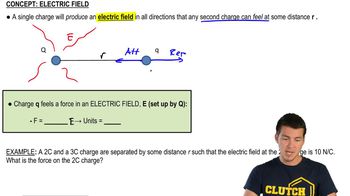
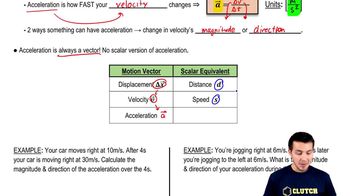
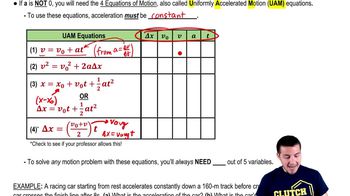
Starting from rest, how long does it take an electron to move 1.0 cm in a steady electric field of magnitude 100 N/C?
Verified step by step guidance
Verified video answer for a similar problem:
Key Concepts
Electric Field
Acceleration
Kinematic Equations
Space explorers discover an 8.7×10¹⁷ kg asteroid that happens to have a positive charge of 4400 C. They would like to place their 3.3×10⁵ kg spaceship in orbit around the asteroid. Interestingly, the solar wind has given their spaceship a charge of −1.2C. What speed must their spaceship have to achieve a 7500-km-diameter circular orbit?
An electric field N/C causes the point charge in FIGURE P22.68 to hang at an angle. What is θ?
Three 1.0 nC charges are placed as shown in FIGURE P22.66. Each of these charges creates an electric field E at a point 3.0 cm in front of the middle charge. What are the three fields E₁, E₂, and E₃ created by the three charges? Write your answer for each as a vector in component form.
A 5.0 g ball charged to 1.5 μC is tied to a 25-cm-long string. It swings at 250 rpm in a horizontal circle around a stationary ball charged to −2.5 μC. What is the tension in the string?
A 10.0 nC charge is located at position (x, y)=(1.0 cm, 2.0 cm). At what (x, y) position(s) is the electric field N/C?
