Ch 10: Interactions and Potential Energy
Knight Calc - Physics for Scientists and Engineers 5th Edition
Knight Calc5th EditionPhysics for Scientists and EngineersISBN: 9780137344796Not the one you use?Change textbook
Chapter 10, Problem 1a

A system of two objects has ΔKtot=7 J\(\Delta\) K_{tot}=7\(\text{ }\)J and ΔU=5 J\(\Delta\) U=-5\(\text{ }\)J. How much work is done by interaction forces?

Verified step by step guidance
1
Step 1: Begin by recalling the work-energy principle, which states that the total work done on a system is equal to the change in its total mechanical energy. The total mechanical energy is the sum of the kinetic energy (K) and potential energy (U).
Step 2: Write the equation for the total work done by interaction forces: \( W_{int} = \Delta K_{tot} + \Delta U \). Here, \( \Delta K_{tot} \) is the change in total kinetic energy, and \( \Delta U \) is the change in potential energy.
Step 3: Substitute the given values into the equation. From the problem, \( \Delta K_{tot} = 7 \, \text{J} \) and \( \Delta U = -5 \, \text{J} \). The equation becomes \( W_{int} = 7 \, \text{J} + (-5 \text{J}) \).
Step 4: Simplify the expression to find the total work done by interaction forces. Combine the values of \( \Delta K_{tot} \) and \( \Delta U \) to determine \( W_{int} \).
Step 5: Conclude that the work done by interaction forces is the result of the sum calculated in Step 4. This represents the energy transferred due to the interaction forces acting within the system.

Verified video answer for a similar problem:

This video solution was recommended by our tutors as helpful for the problem above.
Video duration:
1m
Was this helpful?

Key Concepts

Here are the essential concepts you must grasp in order to answer the question correctly.

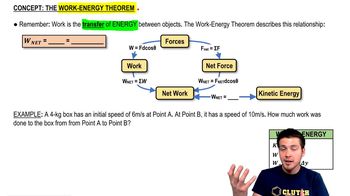
Work-Energy Theorem

The Work-Energy Theorem states that the work done on an object is equal to the change in its kinetic energy. In a system of multiple objects, the total work done by all forces acting on the system can be related to the total change in kinetic energy, which is crucial for solving problems involving motion and energy transfer.
Recommended video:
Guided course
04:10
The Work-Energy Theorem

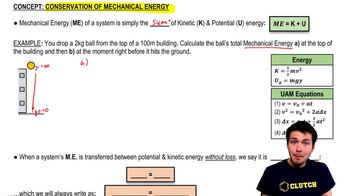
Conservation of Energy

The principle of conservation of energy asserts that energy cannot be created or destroyed, only transformed from one form to another. In this context, the total mechanical energy of the system, which includes kinetic and potential energy, remains constant unless acted upon by external forces, allowing us to relate changes in kinetic and potential energy to work done.
Recommended video:
Guided course
06:24
Conservation Of Mechanical Energy

Interaction Forces

Interaction forces refer to the forces that act between objects in a system, such as gravitational, electromagnetic, or contact forces. These forces can do work on the objects, leading to changes in their kinetic and potential energy. Understanding the nature of these forces is essential for calculating the work done in a system involving multiple objects.
Recommended video:
Guided course
06:48
Intro to Centripetal Forces