
The three identical loudspeakers in FIGURE P17.71 play a 170 Hz tone in a room where the speed of sound is 340 m/s. You are standing 4.0 m in front of the middle speaker. At this point, the amplitude of the wave from each speaker is a. How far must speaker 2 be moved to the left to produce a maximum amplitude at the point where you are standing?
Engineers are testing a new thin-film coating whose index of refraction is less than that of glass. They deposit a 560-nm-thick layer on glass, then shine lasers on it. A red laser with a wavelength of 640 nm has no reflection at all, but a violet laser with a wavelength of 400 nm has a maximum reflection. How the coating behaves at other wavelengths is unknown. What is the coating’s index of refraction?
Verified step by step guidance
Verified video answer for a similar problem:
Key Concepts
Index of Refraction
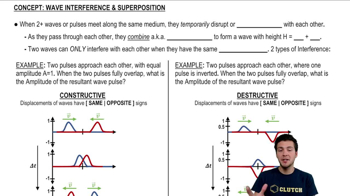
Thin-Film Interference
Wavelength and Reflection
The three identical loudspeakers in FIGURE P17.71 play a 170 Hz tone in a room where the speed of sound is 340 m/s. You are standing 4.0 m in front of the middle speaker. At this point, the amplitude of the wave from each speaker is a. When the amplitude is maximum, by what factor is the sound intensity greater than the sound intensity from a single speaker?
Two loudspeakers emit sound waves of the same frequency along the x-axis. The amplitude of each wave is a. The sound intensity is minimum when speaker 2 is 10 cm behind speaker 1. The intensity increases as speaker 2 is moved forward and first reaches maximum, with amplitude 2a, when it is 30 cm in front of speaker 1. What is The amplitude of the sound (as a multiple of a) if the speakers are placed side by side?
Microwaves with a frequency of 10.5 GHz are aimed downward into a flat-bottomed beaker that contains sunflower oil. A microwave detector above the beaker finds that there are strong reflections when the oil depth is 2.76 cm and 3.68 cm but at no depths in between. What is the index of refraction of sunflower oil at microwave frequencies?
An old mining tunnel disappears into a hillside. You would like to know how long the tunnel is, but it's too dangerous to go inside. Recalling your recent physics class, you decide to try setting up standing-wave resonances inside the tunnel. Using your subsonic amplifier and loudspeaker, you find resonances at 4.5 Hz and 6.3 Hz, and at no frequencies between these. It's rather chilly inside the tunnel, so you estimate the sound speed to be 335 m/s . Based on your measurements, how far is it to the end of the tunnel?
Scientists are testing a transparent material whose index of refraction for visible light varies with wavelength as n = 30.0 nm1/2/λ1/2 , where λ is in nm. If a 295-nm-thick coating is placed on glass (n=1.50), for what visible wavelengths will the reflected light have maximum constructive interference?
