
Ch 17: Superposition
Knight Calc - Physics for Scientists and Engineers 5th Edition
Knight Calc5th EditionPhysics for Scientists and EngineersISBN: 9780137344796Not the one you use?Change textbook
Chapter 17, Problem 65

Engineers are testing a new thin-film coating whose index of refraction is less than that of glass. They deposit a 560-nm-thick layer on glass, then shine lasers on it. A red laser with a wavelength of 640 nm has no reflection at all, but a violet laser with a wavelength of 400 nm has a maximum reflection. How the coating behaves at other wavelengths is unknown. What is the coating’s index of refraction?

Verified step by step guidance
1
Step 1: Understand the problem. The coating is a thin-film layer on glass, and its behavior is described by interference effects. The red laser (640 nm) experiences destructive interference (no reflection), while the violet laser (400 nm) experiences constructive interference (maximum reflection). The goal is to find the index of refraction of the coating.
Step 2: Recall the condition for destructive interference in thin films. Destructive interference occurs when the optical path difference is an odd multiple of half the wavelength in the film. The formula for the optical path difference is: 2tn, where t is the thickness of the film, n is the index of refraction, and the wavelength is adjusted for the medium.
Step 3: Recall the condition for constructive interference in thin films. Constructive interference occurs when the optical path difference is an integer multiple of the wavelength in the film. The same formula applies: 2tn. For the violet laser, this condition is satisfied.
Step 4: Use the given data to set up equations. For the red laser (destructive interference), the condition is: 2tn=mλ2, where λ is the wavelength in the coating and m is an odd integer. For the violet laser (constructive interference), the condition is: 2tn=mλ, where m is an integer.
Step 5: Solve for the index of refraction n. Substitute the thickness t = 560 nm and the wavelengths of the lasers into the equations. Use the fact that the wavelength in the coating is related to the wavelength in air by λ=λn. Solve the system of equations to find n.

Verified video answer for a similar problem:

This video solution was recommended by our tutors as helpful for the problem above.
Was this helpful?

Key Concepts

Here are the essential concepts you must grasp in order to answer the question correctly.

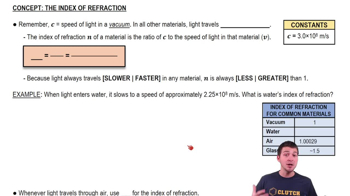
Index of Refraction

The index of refraction (n) is a dimensionless number that describes how light propagates through a medium. It is defined as the ratio of the speed of light in a vacuum to the speed of light in the medium. A lower index of refraction indicates that light travels faster in that medium compared to glass, which has an index of approximately 1.5.
Recommended video:
Guided course
03:46
Index of Refraction

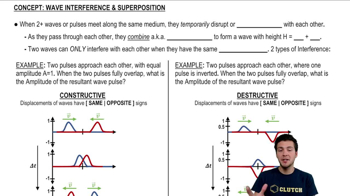
Thin-Film Interference

Thin-film interference occurs when light waves reflect off the boundaries of a thin layer, such as the coating in this scenario. The reflected waves can interfere constructively or destructively depending on the thickness of the film and the wavelength of the light. This phenomenon explains why certain wavelengths experience maximum reflection while others do not, based on the film's thickness and refractive index.
Recommended video:
Guided course
03:47
Wave Interference & Superposition

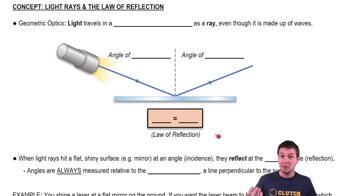
Wavelength and Reflection

The wavelength of light plays a crucial role in determining how it interacts with materials. In this case, the red laser (640 nm) experiences no reflection, indicating that it is likely in a condition of destructive interference, while the violet laser (400 nm) reflects maximally, suggesting constructive interference. The relationship between the wavelength, film thickness, and refractive index is essential for predicting the behavior of light in the coating.
Recommended video:
Guided course
06:25
Law of Reflection
Related Practice
Textbook Question

The three identical loudspeakers in FIGURE P17.71 play a 170 Hz tone in a room where the speed of sound is 340 m/s. You are standing 4.0 m in front of the middle speaker. At this point, the amplitude of the wave from each speaker is a. How far must speaker 2 be moved to the left to produce a maximum amplitude at the point where you are standing?

1817
views
Textbook Question

The three identical loudspeakers in FIGURE P17.71 play a 170 Hz tone in a room where the speed of sound is 340 m/s. You are standing 4.0 m in front of the middle speaker. At this point, the amplitude of the wave from each speaker is a. When the amplitude is maximum, by what factor is the sound intensity greater than the sound intensity from a single speaker?

2186
views
Textbook Question

Two loudspeakers emit sound waves of the same frequency along the x-axis. The amplitude of each wave is a. The sound intensity is minimum when speaker 2 is 10 cm behind speaker 1. The intensity increases as speaker 2 is moved forward and first reaches maximum, with amplitude 2a, when it is 30 cm in front of speaker 1. What is The amplitude of the sound (as a multiple of a) if the speakers are placed side by side?

324
views
Textbook Question

Microwaves with a frequency of 10.5 GHz are aimed downward into a flat-bottomed beaker that contains sunflower oil. A microwave detector above the beaker finds that there are strong reflections when the oil depth is 2.76 cm and 3.68 cm but at no depths in between. What is the index of refraction of sunflower oil at microwave frequencies?

1643
views
Textbook Question

An old mining tunnel disappears into a hillside. You would like to know how long the tunnel is, but it's too dangerous to go inside. Recalling your recent physics class, you decide to try setting up standing-wave resonances inside the tunnel. Using your subsonic amplifier and loudspeaker, you find resonances at 4.5 Hz and 6.3 Hz, and at no frequencies between these. It's rather chilly inside the tunnel, so you estimate the sound speed to be 335 m/s . Based on your measurements, how far is it to the end of the tunnel?

1408
views
Textbook Question

Scientists are testing a transparent material whose index of refraction for visible light varies with wavelength as n = 30.0 nm1/21/2 , where λ is in nm. If a 295-nm-thick coating is placed on glass (n=1.50), for what visible wavelengths will the reflected light have maximum constructive interference?

1337
views