
Ch 31: Electromagnetic Fields and Waves
Knight Calc - Physics for Scientists and Engineers 5th Edition
Knight Calc5th EditionPhysics for Scientists and EngineersISBN: 9780137344796Not the one you use?Change textbook
Chapter 31, Problem 37b

A 10 A current is charging a 1.0-cm-diameter parallel-plate capacitor. What is the magnetic field strength at a point 2.0 mm radially from the center of the capacitor?

Verified step by step guidance
1
Step 1: Recognize that the problem involves calculating the magnetic field strength due to a changing electric field in a parallel-plate capacitor. This is related to Maxwell's equations, specifically the Ampère-Maxwell law, which accounts for the displacement current.
Step 2: Write the Ampère-Maxwell law in integral form: \( \oint \mathbf{B} \cdot d\mathbf{l} = \mu_0 (I + I_d) \), where \( I_d \) is the displacement current. For this problem, the displacement current \( I_d \) is equal to the conduction current \( I \), which is given as 10 A.
Step 3: Use the symmetry of the problem to simplify the calculation. The magnetic field \( B \) is tangential to a circular path around the axis of the capacitor, and its magnitude is constant at a given radius \( r \). The integral simplifies to \( B \cdot 2\pi r \).
Step 4: Solve for \( B \) using the equation \( B \cdot 2\pi r = \mu_0 I \). Rearrange to find \( B = \frac{\mu_0 I}{2\pi r} \), where \( \mu_0 \) is the permeability of free space (\( \mu_0 = 4\pi \times 10^{-7} \ \mathrm{T \cdot m/A} \)), \( I \) is the current (10 A), and \( r \) is the radial distance (2.0 mm or 0.002 m).
Step 5: Substitute the values into the formula \( B = \frac{\mu_0 I}{2\pi r} \) to calculate the magnetic field strength. Ensure all units are consistent (e.g., meters for distance, amperes for current).

Verified video answer for a similar problem:

This video solution was recommended by our tutors as helpful for the problem above.
Video duration:
10m
Was this helpful?

Key Concepts

Here are the essential concepts you must grasp in order to answer the question correctly.

Capacitance

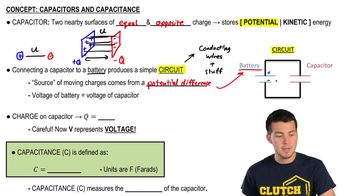
Capacitance is the ability of a capacitor to store charge per unit voltage. It is defined by the formula C = Q/V, where C is capacitance, Q is the charge stored, and V is the voltage across the plates. In this case, the parallel-plate capacitor's capacitance depends on its plate area and the distance between the plates, influencing how much charge it can hold.
Recommended video:
Guided course
08:02
Capacitors & Capacitance (Intro)

Magnetic Field due to Current

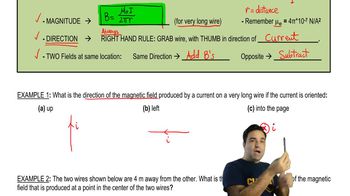
A magnetic field is generated around a conductor when an electric current flows through it. According to Ampère's Law, the magnetic field strength (B) at a distance (r) from a long straight conductor carrying current (I) can be calculated using the formula B = (μ₀I)/(2πr), where μ₀ is the permeability of free space. This principle is essential for determining the magnetic field around the capacitor.
Recommended video:
Guided course
12:33
Magnetic Field Produced by Straight Currents

Radial Distance in Magnetic Fields

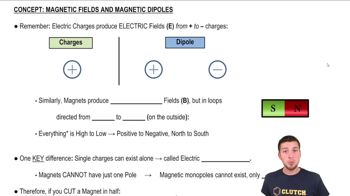
Radial distance refers to the distance measured outward from the center of a circular object, such as the plates of a capacitor. In this context, the magnetic field strength is evaluated at a specific radial distance (2.0 mm) from the center of the capacitor. Understanding how the magnetic field varies with distance is crucial for accurately calculating its strength at that point.
Recommended video:
Guided course
05:30
Magnetic Fields and Magnetic Dipoles
Related Practice
Textbook Question

In FIGURE P31.32, a circular loop of radius r travels with speed v along a charged wire having linear charge density λ. The wire is at rest in the laboratory frame, and it passes through the center of the loop. What electric and magnetic fields would an experimenter in the loop's frame calculate at distance r from the current of part c?

139
views
Textbook Question

A 1.0 μF capacitor is discharged, starting at t = 0 s.The displacement current between the plates is Idisp=(10 A)exp(t2.0 μs)I_{\(\text{disp}\)}=(10\(\text{ A}\))\(\exp\]\left\)(-\(\frac{t}{2.0\text{ }\)}\(\mu\[\text{s}\]\right\)). What was the capacitor’s initial voltage (ΔVC)₀?

105
views
Textbook Question

A simple series circuit consists of a 150 Ω resistor, a 25 V battery, a switch, and a 2.5 pF parallel-plate capacitor (initially uncharged) with plates 5.0 mm apart. The switch is closed at t = 0 s. Find the electric flux and the displacement current at t = 0.50 ns.

100
views
Textbook Question

A wire with conductivity σ carries current I. The current is increasing at the rate dI/dt. Evaluate the displacement current for a copper wire in which the current is increasing at 1.0×10⁶ A/s.

86
views
Textbook Question

At one instant, the electric and magnetic fields at one point of an electromagnetic wave are E=(200i^+300j^50k^) V/m\(\overrightarrow{E}\)=(200\(\hat{i}\)+300\(\hat{j}\)-50\(\hat{k}\))\(\text{ V/m}\) and B=B0(7.3i^7.3j^+ak^) μT\(\overrightarrow{B}\)=B_0(7.3\(\hat{i}\)-7.3\(\hat{j}\)+a\(\hat{k}\))\(\text{ }\[\mu\]\text{T}\). What are the values of aa and B0B_0?

78
views
Textbook Question

FIGURE P31.38 shows the electric field inside a cylinder of radius R=3.0R=3.0 mm. The field strength is increasing with time as E=1.0×10⁸t2E=1.0\(\times\)10^8t^{2} V/m, where t is in s. The electric field outside the cylinder is always zero, and the field inside the cylinder was zero for t<0t<0. Find an expression for the electric flux ΦeΦ_e through the entire cylinder as a function of time.

1745
views