Ch 29: The Magnetic Field
Knight Calc - Physics for Scientists and Engineers 5th Edition
Knight Calc5th EditionPhysics for Scientists and EngineersISBN: 9780137344796Not the one you use?Change textbook
Chapter 29, Problem 37

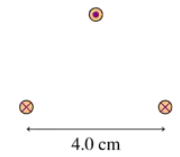
FIGURE EX29.37 is a cross section through three long wires with linear mass density 50 g/m. They each carry equal currents in the directions shown. The lower two wires are 4.0 cm apart and are attached to a table. What current I will allow the upper wire to 'float' so as to form an equilateral triangle with the lower wires?

Verified step by step guidance
1
Understand the problem: The goal is to determine the current \( I \) in the upper wire such that it 'floats' in equilibrium, forming an equilateral triangle with the two lower wires. This means the net force on the upper wire due to the magnetic forces from the lower wires and its weight must be zero.
Step 1: Recall the formula for the magnetic force per unit length between two parallel current-carrying wires. The force per unit length is given by \( F/L = \frac{\mu_0 I_1 I_2}{2 \pi d} \), where \( \mu_0 \) is the permeability of free space, \( I_1 \) and \( I_2 \) are the currents in the wires, and \( d \) is the distance between the wires.
Step 2: Analyze the forces acting on the upper wire. The magnetic forces from the two lower wires will act at an angle of 60° to each other (since the wires form an equilateral triangle). The weight of the upper wire, \( F_g = \lambda g \), where \( \lambda \) is the linear mass density and \( g \) is the acceleration due to gravity, acts vertically downward.
Step 3: Resolve the magnetic forces into components. The horizontal components of the magnetic forces from the two lower wires will cancel out due to symmetry. The vertical components will add up to balance the weight of the upper wire. Use trigonometry to express the vertical component of the magnetic force: \( F_{vertical} = 2 \cdot F_{magnetic} \cdot \sin(60°) \).
Step 4: Set up the equilibrium condition. For the upper wire to float, the total upward magnetic force must equal the downward gravitational force: \( 2 \cdot \frac{\mu_0 I^2}{2 \pi d} \cdot \sin(60°) = \lambda g \). Solve this equation for \( I \), the current in the wires.

Verified video answer for a similar problem:

This video solution was recommended by our tutors as helpful for the problem above.
Video duration:
13m
Was this helpful?

Key Concepts

Here are the essential concepts you must grasp in order to answer the question correctly.

Magnetic Force Between Current-Carrying Wires

When two parallel wires carry electric currents, they exert magnetic forces on each other. The direction of the force depends on the direction of the currents: if the currents are in the same direction, the wires attract; if they are in opposite directions, they repel. This principle is crucial for understanding how the upper wire can 'float' in equilibrium between the lower wires.
Recommended video:
Guided course
09:57
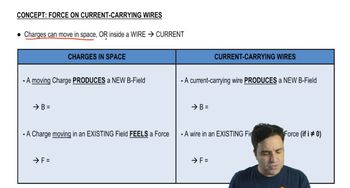
Magnetic Force on Current-Carrying Wire

Equilibrium of Forces

For the upper wire to float and form an equilateral triangle with the lower wires, the net force acting on it must be zero. This means that the magnetic forces exerted by the lower wires on the upper wire must balance out. Analyzing the forces involved allows us to determine the required current in the upper wire to achieve this balance.
Recommended video:

Linear Mass Density and Weight

Linear mass density is defined as mass per unit length of an object, in this case, the wires. The weight of the upper wire, which acts downward due to gravity, is determined by its linear mass density and the length of the wire. This weight must be counteracted by the magnetic forces from the lower wires for the upper wire to remain suspended.
Recommended video:
Guided course
04:33
Problems with Mass, Volume, & Density