
Ch 17: Superposition
Knight Calc - Physics for Scientists and Engineers 5th Edition
Knight Calc5th EditionPhysics for Scientists and EngineersISBN: 9780137344796Not the one you use?Change textbook
Chapter 17, Problem 38

Tendons are, essentially, elastic cords stretched between two fixed ends. As such, they can support standing waves. A woman has a 20-cm-long Achilles tendon—connecting the heel to a muscle in the calf—with a cross-section area of 90 mm2 . The density of tendon tissue is 1100 kg/m3. For a reasonable tension of 500 N, what will be the fundamental frequency of her Achilles tendon?

Verified step by step guidance
1
Step 1: Understand the problem. The Achilles tendon is modeled as a stretched string that can support standing waves. The fundamental frequency corresponds to the lowest frequency of vibration, where the tendon has a single antinode in the middle. The formula for the fundamental frequency is \( f_1 = \frac{1}{2L} \sqrt{\frac{T}{\mu}} \), where \( L \) is the length of the tendon, \( T \) is the tension, and \( \mu \) is the linear mass density.
Step 2: Calculate the linear mass density \( \mu \). The linear mass density is the mass per unit length of the tendon, given by \( \mu = \frac{m}{L} \). The mass \( m \) can be found using the formula \( m = \rho \cdot V \), where \( \rho \) is the density of the tendon tissue and \( V \) is its volume. The volume \( V \) is the product of the cross-sectional area \( A \) and the length \( L \): \( V = A \cdot L \).
Step 3: Substitute the given values to find \( \mu \). The density \( \rho \) is 1100 kg/m^3, the cross-sectional area \( A \) is 90 mm^2 (convert to m^2: \( 90 \times 10^{-6} \) m^2), and the length \( L \) is 20 cm (convert to meters: \( 0.2 \) m). First, calculate the volume \( V \), then the mass \( m \), and finally the linear mass density \( \mu \).
Step 4: Substitute \( \mu \) and \( T \) into the formula for the fundamental frequency. The tension \( T \) is given as 500 N. Use the formula \( f_1 = \frac{1}{2L} \sqrt{\frac{T}{\mu}} \), where \( L \) is 0.2 m, \( T \) is 500 N, and \( \mu \) is the linear mass density calculated in the previous step.
Step 5: Simplify the expression to find the fundamental frequency \( f_1 \). Perform the square root and division operations as needed. The result will give the fundamental frequency in hertz (Hz).

Verified video answer for a similar problem:

This video solution was recommended by our tutors as helpful for the problem above.
Video duration:
5m
Was this helpful?

Key Concepts

Here are the essential concepts you must grasp in order to answer the question correctly.

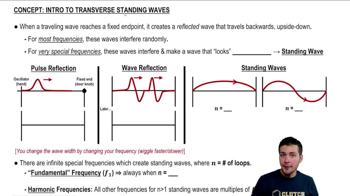
Standing Waves

Standing waves occur when two waves of the same frequency and amplitude travel in opposite directions and interfere with each other. In the context of a tendon, these waves can form due to the tension and elasticity of the material, creating nodes and antinodes along its length. Understanding standing waves is crucial for analyzing how tendons can vibrate and transmit frequencies.
Recommended video:
Guided course
07:58
Intro to Transverse Standing Waves

Fundamental Frequency

The fundamental frequency is the lowest frequency at which a system can vibrate, corresponding to the first harmonic. For a fixed string or cord, this frequency depends on the length, tension, and mass per unit length of the material. In the case of the Achilles tendon, calculating the fundamental frequency involves using the tension and physical dimensions of the tendon.
Recommended video:
Guided course
05:08
Circumference, Period, and Frequency in UCM

Tension and Elasticity

Tension refers to the force applied along the length of an object, which in this case is the force exerted on the Achilles tendon. Elasticity is the ability of a material to return to its original shape after deformation. The relationship between tension, elasticity, and the physical properties of the tendon is essential for determining how it vibrates and the frequencies it can support.
Recommended video:
Guided course
08:56
Intro To Elastic Collisions
Related Practice
Textbook Question

Two strings are adjusted to vibrate at exactly 200 Hz. Then the tension in one string is increased slightly. Afterward, three beats per second are heard when the strings vibrate at the same time. What is the new frequency of the string that was tightened?

1616
views
Textbook Question

In a laboratory experiment, one end of a horizontal string is tied to a support while the other end passes over a frictionless pulley and is tied to a 1.5 kg sphere. Students determine the frequencies of standing waves on the horizontal segment of the string, then they raise a beaker of water until the hanging 1.5 kg sphere is completely submerged. The frequency of the fifth harmonic with the sphere submerged exactly matches the frequency of the third harmonic before the sphere was submerged. What is the diameter of the sphere?

238
views
Textbook Question

A 2.0-m-long string vibrates at its second-harmonic frequency with a maximum amplitude of 2.0 cm. One end of the string is at x = 0 cm. Find the oscillation amplitude at x = 10, 20, 30, 40, and 50 cm.

1166
views
Textbook Question

A flute player hears four beats per second when she compares her note to a 523 Hz tuning fork (the note C). She can match the frequency of the tuning fork by pulling out the 'tuning joint' to lengthen her flute slightly. What was her initial frequency?

1628
views
Textbook Question

A violinist places her finger so that the vibrating section of a 1.0 g/m string has a length of 30 cm, then she draws her bow across it. A listener nearby in a 20°C room hears a note with a wavelength of 40 cm. What is the tension in the string?

1307
views
Textbook Question

INT One end of a 75-cm-long, 2.5 g guitar string is attached to a spring. The other end is pulled, which stretches the spring. The guitar string's second harmonic occurs at 550 Hz when the spring has been stretched by 5.0 cm. What is the value of the spring constant?

1866
views