Ch 23: The Electric Field
Knight Calc - Physics for Scientists and Engineers 5th Edition
Knight Calc5th EditionPhysics for Scientists and EngineersISBN: 9780137344796Not the one you use?Change textbook
Chapter 23, Problem 72

One type of ink-jet printer, called an electrostatic ink-jet printer, forms the letters by using deflecting electrodes to steer charged ink drops up and down vertically as the ink jet sweeps horizontally across the page. The ink jet forms 30-μm-diameter drops of ink, charges them by spraying 800,000 electrons on the surface, and shoots them toward the page at a speed of 20 m/s . Along the way, the drops pass through two horizontal, parallel electrodes that are 6.0 mm long, 4.0 mm wide, and spaced 1.0 mm apart. The distance from the center of the electrodes to the paper is 2.0 cm. To form the tallest letters, which have a height of 6.0 mm, the drops need to be deflected upward (or downward) by 3.0 mm. What electric field strength is needed between the electrodes to achieve this deflection? Ink, which consists of dye particles suspended in alcohol, has a density of 800 kg/m3.

Verified step by step guidance
1
Step 1: Calculate the mass of a single ink drop. The volume of a spherical ink drop can be calculated using the formula for the volume of a sphere: \( V = \frac{4}{3} \pi r^3 \), where \( r \) is the radius of the drop. The radius is half the diameter, so \( r = 15 \times 10^{-6} \, \text{m} \). Multiply the volume by the density of the ink (\( \rho = 800 \; \text{kg/m}^3 \)) to find the mass: \( m = \rho V \).
Step 2: Determine the charge on the ink drop. The charge \( q \) is given by the number of electrons sprayed onto the drop multiplied by the charge of a single electron: \( q = n e \), where \( n = 800,000 \) and \( e = 1.6 \times 10^{-19} \, \text{C} \).
Step 3: Relate the electric force to the deflection. The electric force \( F = qE \) (where \( E \) is the electric field strength) causes the ink drop to accelerate vertically. Use Newton's second law \( F = ma \) to find the vertical acceleration \( a \), where \( m \) is the mass of the drop calculated in Step 1.
Step 4: Use kinematics to find the required acceleration. The vertical deflection \( y \) is 3.0 mm (\( 3.0 \times 10^{-3} \; \text{m} \)), and the horizontal distance traveled through the electrodes is 6.0 mm (\( 6.0 \times 10^{-3} \; \text{m} \)). The time \( t \) it takes to traverse the electrodes is \( t = \frac{d}{v} \), where \( d \) is the length of the electrodes and \( v = 20 \; \text{m/s} \) is the horizontal velocity. Use the kinematic equation \( y = \frac{1}{2} a t^2 \) to solve for \( a \).
Step 5: Solve for the electric field strength \( E \). Rearrange the equation \( F = qE \) to find \( E = \frac{F}{q} \), where \( F = ma \) and \( a \) is the acceleration found in Step 4. Substitute the values of \( m \), \( a \), and \( q \) to calculate \( E \).

Verified video answer for a similar problem:

This video solution was recommended by our tutors as helpful for the problem above.
Video duration:
13m
Was this helpful?

Key Concepts

Here are the essential concepts you must grasp in order to answer the question correctly.

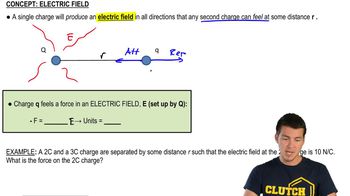
Electric Field

An electric field is a region around a charged particle where other charged particles experience a force. It is defined as the force per unit charge and is measured in volts per meter (V/m). In the context of the electrostatic ink-jet printer, the electric field between the electrodes influences the trajectory of the charged ink drops, allowing for their deflection as they travel toward the paper.
Recommended video:
Guided course
03:16
Intro to Electric Fields

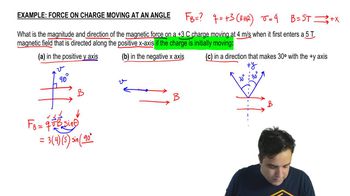
Force on a Charged Particle

The force experienced by a charged particle in an electric field is given by the equation F = qE, where F is the force, q is the charge of the particle, and E is the electric field strength. This force determines how much the charged ink drops will be deflected as they pass through the electric field created by the electrodes. Understanding this relationship is crucial for calculating the required electric field strength to achieve the desired deflection.
Recommended video:
Guided course
06:21
Force on Charge Moving at an Angle

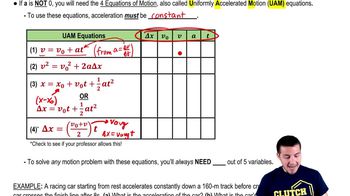
Kinematics of Motion

Kinematics is the branch of mechanics that deals with the motion of objects without considering the forces that cause the motion. In this scenario, the speed of the ink drops (20 m/s) and the distance they need to be deflected (3.0 mm) are essential for determining the time the drops spend in the electric field. This information is necessary to calculate the required electric field strength to achieve the desired deflection of the ink drops.
Recommended video:
Guided course
08:25
Kinematics Equations