Ch 09: Work and Kinetic Energy
Knight Calc - Physics for Scientists and Engineers 5th Edition
Knight Calc5th EditionPhysics for Scientists and EngineersISBN: 9780137344796Not the one you use?Change textbook
Chapter 9, Problem 30

A horizontal spring with spring constant 85 N/m extends outward from a wall just above floor level. A 1.5 kg box sliding across a frictionless floor hits the end of the spring and compresses it 6.5 cm before the spring expands and shoots the box back out. How fast was the box going when it hit the spring?

Verified step by step guidance
1
Step 1: Recognize that this is a conservation of energy problem. The box's initial kinetic energy is converted entirely into the elastic potential energy of the spring when it is fully compressed. The equation for conservation of energy is: \( \frac{1}{2} m v^2 = \frac{1}{2} k x^2 \), where \( m \) is the mass of the box, \( v \) is its initial velocity, \( k \) is the spring constant, and \( x \) is the compression of the spring.
Step 2: Rearrange the equation to solve for the initial velocity \( v \). The formula becomes: \( v = \sqrt{\frac{k x^2}{m}} \).
Step 3: Convert the spring compression \( x \) from centimeters to meters, as SI units are required for consistency. Since \( 6.5 \ \text{cm} = 0.065 \ \text{m} \), substitute \( x = 0.065 \ \text{m} \) into the equation.
Step 4: Substitute the given values for the spring constant \( k = 85 \ \text{N/m} \) and the mass of the box \( m = 1.5 \ \text{kg} \) into the formula for \( v \). The equation becomes: \( v = \sqrt{\frac{85 \cdot (0.065)^2}{1.5}} \).
Step 5: Simplify the expression under the square root to find the initial velocity \( v \). This will give the speed of the box when it first hit the spring.

Verified video answer for a similar problem:

This video solution was recommended by our tutors as helpful for the problem above.
Video duration:
8m
Was this helpful?

Key Concepts

Here are the essential concepts you must grasp in order to answer the question correctly.

Hooke's Law

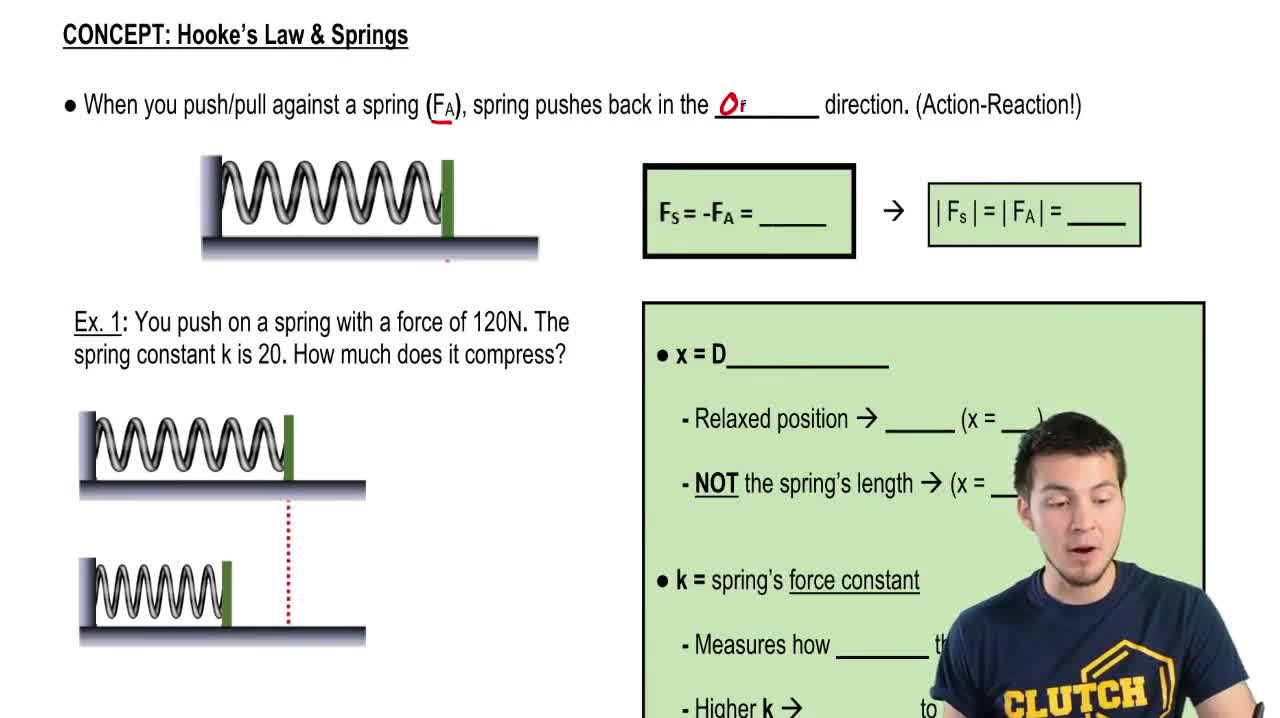
Hooke's Law states that the force exerted by a spring is directly proportional to its displacement from the equilibrium position, expressed as F = -kx, where F is the force, k is the spring constant, and x is the displacement. This principle is crucial for understanding how the spring behaves when compressed by the box.
Recommended video:
Guided course
05:27
Spring Force (Hooke's Law)

Conservation of Energy

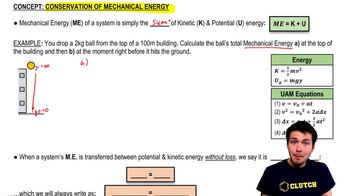
The principle of conservation of energy states that energy cannot be created or destroyed, only transformed from one form to another. In this scenario, the kinetic energy of the box is converted into potential energy stored in the compressed spring, allowing us to calculate the box's initial speed using energy equations.
Recommended video:
Guided course
06:24
Conservation Of Mechanical Energy

Kinetic Energy

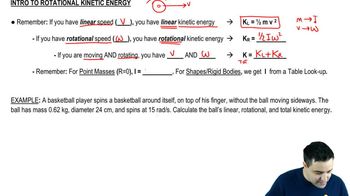
Kinetic energy is the energy possessed by an object due to its motion, calculated using the formula KE = 1/2 mv², where m is the mass and v is the velocity. Understanding kinetic energy is essential for determining how fast the box was moving before it hit the spring, as this energy is transformed into potential energy during compression.
Recommended video:
Guided course
06:07
Intro to Rotational Kinetic Energy