
Ch 07: Newton's Third Law
Knight Calc - Physics for Scientists and Engineers 5th Edition
Knight Calc5th EditionPhysics for Scientists and EngineersISBN: 9780137344796Not the one you use?Change textbook
Chapter 7, Problem 17b

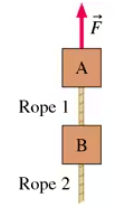
FIGURE EX7.17 shows two 1.0 kg blocks connected by a rope. A second rope hangs beneath the lower block. Both ropes have a mass of 250 g. The entire assembly is accelerated upward at 3.0 m/s2 by force F. What is the tension at the top end of rope 1?

Verified step by step guidance
1
Step 1: Identify the forces acting on the system. The system consists of two blocks (each 1.0 kg) and two ropes (each 0.25 kg). The forces include the gravitational force acting downward on each block and rope, and the upward force F exerted to accelerate the system.
Step 2: Calculate the total mass of the system. Add the masses of the two blocks and the two ropes: \( m_{total} = m_{block1} + m_{block2} + m_{rope1} + m_{rope2} \).
Step 3: Determine the net force required to accelerate the system upward. Use Newton's second law \( F_{net} = m_{total} \cdot a \), where \( a \) is the acceleration (3.0 m/s²).
Step 4: Analyze the tension at the top end of rope 1. The tension at this point must support the weight of the lower block, the lower rope, and provide the force necessary to accelerate them upward. Use \( T_{rope1} = (m_{block2} + m_{rope2}) \cdot (g + a) \), where \( g \) is the acceleration due to gravity (9.8 m/s²).
Step 5: Substitute the values for \( m_{block2} \), \( m_{rope2} \), \( g \), and \( a \) into the equation from Step 4 to find the tension at the top end of rope 1.

Verified video answer for a similar problem:

This video solution was recommended by our tutors as helpful for the problem above.
Video duration:
10m
Was this helpful?

Key Concepts

Here are the essential concepts you must grasp in order to answer the question correctly.

Newton's Second Law of Motion

Newton's Second Law states that the acceleration of an object is directly proportional to the net force acting on it and inversely proportional to its mass. This relationship is expressed by the equation F = ma, where F is the net force, m is the mass, and a is the acceleration. In this scenario, understanding how the forces acting on the blocks relate to their acceleration is crucial for calculating tension.
Recommended video:
Guided course
06:54
Intro to Forces & Newton's Second Law

Tension in a Rope

Tension is the force transmitted through a rope or string when it is pulled tight by forces acting at either end. In a system of connected objects, the tension varies depending on the mass of the objects and the acceleration of the system. Calculating the tension at different points in the rope requires considering the weight of the blocks and the net force acting on them.
Recommended video:
Guided course
06:34
Calculating Tension in a Pendulum with Energy Conservation

Free Body Diagram

A Free Body Diagram (FBD) is a graphical representation used to visualize the forces acting on an object. It helps in identifying all the forces, including gravitational force, tension, and any applied forces. For this problem, drawing FBDs for each block will aid in understanding how the forces interact and will facilitate the calculation of the tension in the ropes.
Recommended video:
Guided course
08:42
Free-Body Diagrams
Related Practice
Textbook Question

A mobile at the art museum has a 2.0 kg steel cat and a 4.0 kg steel dog suspended from a lightweight cable, as shown in FIGURE EX7.21. It is found that θ1\(\theta\)_1 = 20° when the center rope is adjusted to be perfectly horizontal. What are the tension and the angle of rope 3?

3886
views
1
rank
1
comments
Textbook Question

A 2.0-m-long, 500 g rope pulls a 10 kg block of ice across a horizontal, frictionless surface. The block accelerates at 2.0 m/s2. How much force pulls forward on he rope? Assume that the rope is perfectly horizontal.

2108
views
Textbook Question

The foot of a 55 kg sprinter is on the ground for 0.25 s while her body accelerates from rest to 2.0 m/s. What is the magnitude of the friction force?

2133
views
Textbook Question

A 500 kg air conditioner sits on the flat roof of a building. The coefficient of static friction between the roof and the air conditioner is 0.90. A massless rope attached to the air conditioner passes over a massless, frictionless pulley at the edge of the roof. In an effort to drag the air conditioner to the edge of the roof, four 100 kg students hang from the free end of the rope, but the air conditioner refuses to budge. What is the magnitude of the rope tension at the point where it is attached to the air conditioner?

2138
views
Textbook Question

The sled dog in FIGURE EX7.15 drags sleds A and B across the snow. The coefficient of friction between the sleds and the snow is 0.10. If the tension in rope 1 is 150 N, what is the tension in rope 2?

572
views
Textbook Question

Blocks with masses of 1 kg, 2 kg, and 3 kg are lined up in a row on a frictionless table. All three are pushed forward by a 12 N force applied to the 1 kg block. How much force does the 2 kg block exert on the 1 kg block?

3658
views