

Ch 13: Newton's Theory of Gravity
Knight Calc - Physics for Scientists and Engineers 5th Edition
Knight Calc5th EditionPhysics for Scientists and EngineersISBN: 9780137344796Not the one you use?Change textbook
Chapter 13, Problem 20b

You have been visiting a distant planet. Your measurements have determined that the planet's mass is twice that of earth but the free-fall acceleration at the surface is only one-fourth as large. To get back to earth, you need to escape the planet. What minimum speed does your rocket need?

Verified step by step guidance
1
Understand the problem: The escape velocity is the minimum speed required for an object to escape the gravitational pull of a planet without further propulsion. The formula for escape velocity is \( v_{e} = \sqrt{\frac{2GM}{R}} \), where \( G \) is the gravitational constant, \( M \) is the mass of the planet, and \( R \) is the radius of the planet.
Relate the given information: The mass of the planet is \( M = 2M_{\text{Earth}} \), and the free-fall acceleration \( g = \frac{GM}{R^2} \) is given as \( g = \frac{1}{4}g_{\text{Earth}} \). Use this to find the radius \( R \) of the planet in terms of Earth's radius \( R_{\text{Earth}} \).
Set up the ratio for free-fall acceleration: \( \frac{GM}{R^2} = \frac{1}{4} \cdot \frac{GM_{\text{Earth}}}{R_{\text{Earth}}^2} \). Substitute \( M = 2M_{\text{Earth}} \) into the equation to solve for \( R \) in terms of \( R_{\text{Earth}} \).
Substitute \( M \) and \( R \) into the escape velocity formula: Replace \( M \) with \( 2M_{\text{Earth}} \) and \( R \) with the value derived in the previous step. The escape velocity formula becomes \( v_{e} = \sqrt{\frac{2G(2M_{\text{Earth}})}{R}} \).
Simplify the expression for \( v_{e} \): Use the relationship between \( R \) and \( R_{\text{Earth}} \) to express \( v_{e} \) in terms of Earth's escape velocity \( v_{e, \text{Earth}} = \sqrt{\frac{2GM_{\text{Earth}}}{R_{\text{Earth}}}} \). This will give you the escape velocity for the planet relative to Earth's escape velocity.

Verified video answer for a similar problem:

This video solution was recommended by our tutors as helpful for the problem above.
Video duration:
14m
Was this helpful?

Key Concepts

Here are the essential concepts you must grasp in order to answer the question correctly.

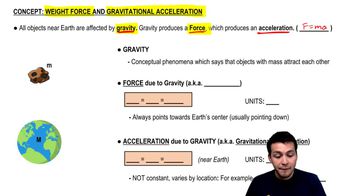
Gravitational Acceleration

Gravitational acceleration is the acceleration experienced by an object due to the gravitational force exerted by a massive body, such as a planet. It is typically denoted by 'g' and varies depending on the mass of the planet and the distance from its center. On Earth, this value is approximately 9.81 m/s², but it can be different on other planets, as indicated in the question where the acceleration is one-fourth that of Earth's.
Recommended video:
Guided course
07:32
Weight Force & Gravitational Acceleration

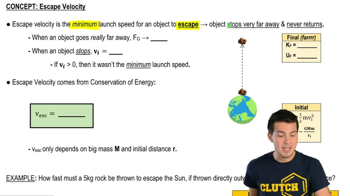
Escape Velocity

Escape velocity is the minimum speed an object must reach to break free from a planet's gravitational pull without any further propulsion. It is derived from the balance of kinetic energy and gravitational potential energy. The formula for escape velocity (v) is given by v = √(2GM/r), where G is the gravitational constant, M is the mass of the planet, and r is the radius of the planet. Understanding this concept is crucial for determining the speed needed for a rocket to leave the planet.
Recommended video:
Guided course
7:27
Escape Velocity

Mass and Radius Relationship

The relationship between mass and radius is essential in understanding gravitational forces and escape velocity. In the context of the question, the planet's mass is twice that of Earth, but the free-fall acceleration is one-fourth, suggesting a larger radius. This relationship affects the gravitational force experienced at the surface and is critical for calculating escape velocity, as both mass and radius are key variables in the escape velocity formula.
Recommended video:
Guided course
20:32
Mass Spectrometers
Related Practice
Textbook Question

You have been visiting a distant planet. Your measurements have determined that the planet's mass is twice that of earth but the free-fall acceleration at the surface is only one-fourth as large. What is the planet's radius?

1367
views
Textbook Question

A space station orbits the sun at the same distance as the earth but on the opposite side of the sun. A small probe is fired away from the station. What minimum speed does the probe need to escape the solar system?

1701
views
Textbook Question

Two stars, one twice as massive as the other, are 1.0 light year (ly) apart. One light year is the distance light travels in one year at the speed of light, 3.00 ✕ 108 m/s . The gravitational potential energy of this double-star system is - 8.0 ✕ 1034 J. What is the mass of the lighter star?

1635
views
Textbook Question

Three satellites orbit a planet of radius R, as shown in FIGURE EX13.24. Satellites S1 and S3 have mass m. Satellite S2 has mass 2m. Satellite S1 orbits in 250 minutes and the force on S1 is 10,000 N. What is the kinetic-energy ratio for K1 / K3 for S1 and S3?

1501
views
Textbook Question

Nothing can escape the event horizon of a black hole, not even light. You can think of the event horizon as being the distance from a black hole at which the escape speed is the speed of light, 3.00 ✕ 10⁸ m/s, making all escape impossible. What is the radius of the event horizon for a black hole with a mass 5.0 times the mass of the sun? This distance is called the Schwarzschild radius.

3007
views
Textbook Question

A binary star system has two stars, each with the same mass as our sun, separated by 1.0 ✕ 1012 m. A comet is very far away and essentially at rest. Slowly but surely, gravity pulls the comet toward the stars. Suppose the comet travels along a trajectory that passes through the midpoint between the two stars. What is the comet's speed at the midpoint?

925
views