
Textbook Question
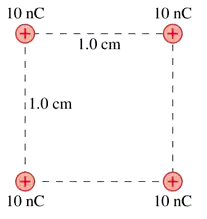
A proton's speed as it passes point 1 is 50,000 m/s. It follows the trajectory shown in FIGURE P25.43. What is the proton's speed at point 2?
2240
views

 Verified step by step guidance
 06:24
06:24
 06:07
06:07 06:48
06:48A proton's speed as it passes point 1 is 50,000 m/s. It follows the trajectory shown in FIGURE P25.43. What is the proton's speed at point 2?
A +3.0 nC charge is at x=0 cm and a −1.0 nC charge is at x=4 cm. At what point or points on the x-axis is the electric potential zero?
An arrangement of source charges produces the electric potential V=5000x2 along the x-axis, where V is in volts and x is in meters. What is the maximum speed of a 1.0 g, 10 nC charged particle that moves in this potential with turning points at ±8.0 cm?
A −3.0 nC charge is on the x-axis at x=−9 cm and a +4.0 nC charge is on the x-axis at x=16 cm. At what point or points on the y-axis is the electric potential zero?
Two small metal cubes with masses 2.0 g and 4.0 g are tied together by a 5.0-cm-long massless string and are at rest on a frictionless surface. Each is charged to +2.0 μC. What is the tension in the string?
Living cells 'pump' singly ionized sodium ions, Na+, from the inside of the cell to the outside to maintain a membrane potential ΔVmembrane=Vin−Vout=−70 mV. It is called pumping because work must be done to move a positive ion from the negative inside of the cell to the positive outside, and it must go on continuously because sodium ions 'leak' back through the cell wall by diffusion. At rest, the human body uses energy at the rate of approximately 100 W to maintain basic metabolic functions. It has been estimated that 20% of this energy is used to operate the sodium pumps of the body. Estimate—to one significant figure—the number of sodium ions pumped per second.