Ch 23: The Electric Field
Knight Calc - Physics for Scientists and Engineers 5th Edition
Knight Calc5th EditionPhysics for Scientists and EngineersISBN: 9780137344796Not the one you use?Change textbook
Chapter 23, Problem 73

A proton orbits a long charged wire, making 1.0×1061.0×10^6 revolutions per second. The radius of the orbit is 1.01.0 cm. What is the wire's linear charge density?

Verified step by step guidance
1
Start by identifying the force acting on the proton. The centripetal force required to keep the proton in circular motion is provided by the electrostatic force between the proton and the charged wire. The centripetal force is given by: Fc = mv2/r, where m is the mass of the proton, v is its velocity, and r is the radius of the orbit.
The electrostatic force between the proton and the charged wire is given by: Fe = qE, where q is the charge of the proton and E is the electric field due to the charged wire. For a long charged wire, the electric field at a distance r is given by: E = 2kλ/r, where λ is the linear charge density and k is Coulomb's constant.
Equate the centripetal force to the electrostatic force: mv2/r = q(2kλ/r). Simplify the equation to solve for λ: λ = (mv2)/(2kq).
Determine the velocity of the proton. The proton completes 1.0 × 10⁶ revolutions per second, so its angular velocity is ω = 2π(1.0 × 10⁶). The linear velocity is related to the angular velocity by v = ωr. Substitute the radius r = 0.01 m to find v.
Substitute the known values into the expression for λ. Use m = 1.67 × 10⁻²⁷ kg (mass of a proton), q = 1.6 × 10⁻¹⁹ C (charge of a proton), k = 8.99 × 10⁹ N·m2/C2, and the calculated value of v. Solve for λ.

Verified video answer for a similar problem:

This video solution was recommended by our tutors as helpful for the problem above.
Video duration:
14m
Was this helpful?

Key Concepts

Here are the essential concepts you must grasp in order to answer the question correctly.

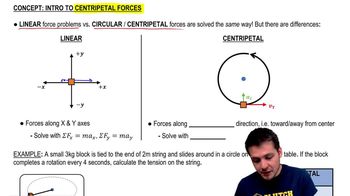
Centripetal Force

Centripetal force is the net force acting on an object moving in a circular path, directed towards the center of the circle. For a charged particle like a proton orbiting a charged wire, this force is provided by the electric field created by the wire. The balance between the centripetal force required for circular motion and the electric force due to the wire's charge is crucial for determining the wire's charge density.
Recommended video:
Guided course
06:48
Intro to Centripetal Forces

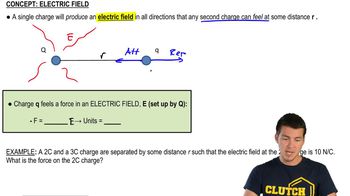
Electric Field and Force

The electric field around a charged object exerts a force on other charges within that field. For a long charged wire, the electric field can be calculated using Gauss's law, which relates the electric field to the linear charge density. The force experienced by the proton due to this electric field is what keeps it in circular motion, allowing us to relate the charge density to the proton's orbit.
Recommended video:
Guided course
03:16
Intro to Electric Fields

Linear Charge Density

Linear charge density is defined as the amount of electric charge per unit length along a charged object, such as a wire. It is denoted by the symbol λ (lambda) and is measured in coulombs per meter (C/m). In this problem, calculating the linear charge density of the wire involves using the relationship between the electric field produced by the wire and the centripetal force acting on the proton in its circular orbit.
Recommended video:
Guided course
8:13
Intro to Density