Ch 04: Kinematics in Two Dimensions
Knight Calc - Physics for Scientists and Engineers 5th Edition
Knight Calc5th EditionPhysics for Scientists and EngineersISBN: 9780137344796Not the one you use?Change textbook
Chapter 4, Problem 5b

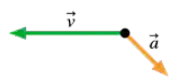
Is this particle curving upward, curving downward, or moving in a straight line?

Verified step by step guidance
1
Step 1: Observe the image provided. The green arrow represents the velocity vector \( \mathbf{v} \), and the blue arrow represents the acceleration vector \( \mathbf{a} \). The velocity vector is directed horizontally to the left, while the acceleration vector is directed downward and to the right.
Step 2: Recall that the direction of the acceleration vector relative to the velocity vector determines the curvature of the particle's path. If the acceleration has a component perpendicular to the velocity, the path will curve.
Step 3: Analyze the components of the acceleration vector \( \mathbf{a} \). The acceleration vector has a downward component (perpendicular to \( \mathbf{v} \)) and a rightward component (opposite to the direction of \( \mathbf{v} \)). The perpendicular component causes the path to curve downward.
Step 4: Understand that the downward curvature occurs because the perpendicular component of \( \mathbf{a} \) pulls the particle away from a straight-line trajectory. The rightward component of \( \mathbf{a} \) reduces the magnitude of the leftward velocity but does not affect the curvature direction.
Step 5: Conclude that the particle is curving downward due to the downward component of the acceleration vector \( \mathbf{a} \).

Verified video answer for a similar problem:

This video solution was recommended by our tutors as helpful for the problem above.
Video duration:
55s
Was this helpful?

Key Concepts

Here are the essential concepts you must grasp in order to answer the question correctly.

Velocity

Velocity is a vector quantity that describes the rate of change of an object's position with respect to time. It has both magnitude and direction, which means it indicates how fast an object is moving and in which direction. In the context of the question, the velocity vector is shown pointing to the right, indicating the direction of the particle's motion.
Recommended video:
Guided course
7:27
Escape Velocity

Acceleration

Acceleration is also a vector quantity that represents the rate of change of velocity over time. It can indicate changes in the speed or direction of an object's motion. In the provided diagram, the acceleration vector points downward, suggesting that the particle is experiencing a change in its velocity that could affect its trajectory, potentially causing it to curve.
Recommended video:
Guided course
05:47
Intro to Acceleration

Curvature of Motion

The curvature of motion refers to how the path of an object changes direction over time. If the acceleration vector is not aligned with the velocity vector, it indicates that the object is not moving in a straight line. In this case, since the acceleration is directed downward while the velocity is horizontal, the particle is curving downward, indicating a change in its trajectory.
Recommended video:
Guided course
05:36
Intro to Satellite Motion