

Ch 30: Electromagnetic Induction
Knight Calc - Physics for Scientists and Engineers 5th Edition
Knight Calc5th EditionPhysics for Scientists and EngineersISBN: 9780137344796Not the one you use?Change textbook
Chapter 30, Problem 2a

INT A 10-cm-long wire is pulled along a U-shaped conducting rail in a perpendicular magnetic field. The total resistance of the wire and rail is 0.20 Ω. Pulling the wire at a steady speed of 4.0 m/s causes 4.0 W of power to be dissipated in the circuit. How big is the pulling force?

Verified step by step guidance
1
Step 1: Begin by understanding the relationship between power, resistance, and current. The power dissipated in the circuit is given as 4.0 W, and the total resistance is 0.20 Ω. Use the formula for power dissipation in terms of current: P = I²R, where P is power, I is current, and R is resistance. Rearrange the formula to solve for the current: I = √(P / R).
Step 2: Once the current is determined, calculate the induced electromotive force (EMF) in the circuit using Ohm's Law: EMF = I × R. This EMF is generated due to the motion of the wire in the magnetic field.
Step 3: Recall Faraday's Law of Induction, which relates the EMF to the motion of the wire in the magnetic field. The EMF can also be expressed as EMF = B × L × v, where B is the magnetic field strength, L is the length of the wire, and v is the velocity of the wire. Use this formula to find the magnetic field strength (B) if needed.
Step 4: The pulling force required to move the wire at a steady speed can be calculated using the formula F = I × B × L, where F is the force, I is the current, B is the magnetic field strength, and L is the length of the wire. Substitute the values obtained for I, B, and L into this formula.
Step 5: Ensure all units are consistent (e.g., meters for length, seconds for time) and verify the calculations step by step to ensure accuracy. The pulling force is the final result obtained from the formula F = I × B × L.

Verified video answer for a similar problem:

This video solution was recommended by our tutors as helpful for the problem above.
Video duration:
2m
Was this helpful?

Key Concepts

Here are the essential concepts you must grasp in order to answer the question correctly.

Electromagnetic Induction

Electromagnetic induction is the process by which a changing magnetic field within a closed loop induces an electromotive force (EMF) in the wire. In this scenario, as the wire moves through the magnetic field, it cuts through magnetic lines of force, generating an EMF that drives current through the circuit.
Recommended video:
Guided course
05:42
Introduction to Induction

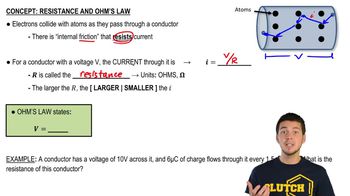
Ohm's Law

Ohm's Law states that the current (I) flowing through a conductor between two points is directly proportional to the voltage (V) across the two points and inversely proportional to the resistance (R) of the conductor. This relationship can be expressed as V = IR, which is essential for calculating the current in the circuit when the power and resistance are known.
Recommended video:
Guided course
03:07
Resistance and Ohm's Law

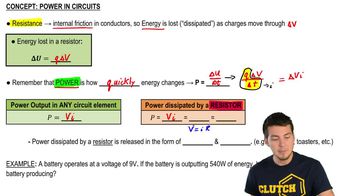
Power in Electrical Circuits

Power (P) in electrical circuits is defined as the rate at which electrical energy is converted to another form of energy, such as heat. It can be calculated using the formula P = IV, where I is the current and V is the voltage. In this case, knowing the power dissipated allows us to find the current flowing through the circuit, which is crucial for determining the pulling force.
Recommended video:
Guided course
06:18
Power in Circuits