A 2.0-cm-diameter parallel-plate capacitor with a spacing of 0.50 mm is charged to 200 V. What are (a) the total energy stored in the electric field and (b) the energy density?
Ch 26: Potential and Field
Knight Calc5th EditionPhysics for Scientists and EngineersISBN: 9780137344796Not the one you use?Change textbook
Chapter 26, Problem 27
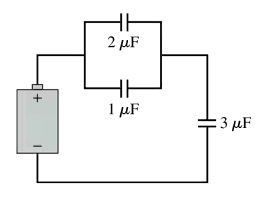
What is the equivalent capacitance of the three capacitors in FIGURE EX26.27?

Verified step by step guidance1
Step 1: Identify the configuration of the capacitors in the circuit (series or parallel). In FIGURE EX26.27, check whether the capacitors are connected end-to-end (series) or share common terminals (parallel).
Step 2: For capacitors in series, use the formula: , where C is the equivalent capacitance and C₁, C₂, C₃ are the individual capacitances.
Step 3: For capacitors in parallel, use the formula: , where C is the equivalent capacitance and C₁, C₂, C₃ are the individual capacitances.
Step 4: Substitute the given values of the capacitances from FIGURE EX26.27 into the appropriate formula based on the configuration determined in Step 1.
Step 5: Simplify the expression to find the equivalent capacitance. Ensure units are consistent (e.g., microfarads) throughout the calculation.

Verified video answer for a similar problem:
This video solution was recommended by our tutors as helpful for the problem above.
Was this helpful?
Key Concepts
Here are the essential concepts you must grasp in order to answer the question correctly.
Capacitance
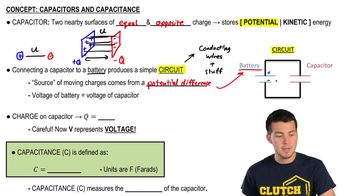
Capacitance is the ability of a capacitor to store electrical charge per unit voltage. It is measured in farads (F) and is defined as the ratio of the charge (Q) stored on one plate to the voltage (V) across the plates, expressed as C = Q/V. Understanding capacitance is essential for analyzing how capacitors behave in circuits.
Recommended video:
Guided course
Capacitors & Capacitance (Intro)
Series and Parallel Capacitors
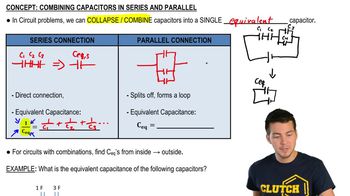
Capacitors can be connected in series or parallel, affecting the total capacitance of the circuit. In series, the total capacitance (C_total) is given by 1/C_total = 1/C1 + 1/C2 + ... for each capacitor, resulting in a lower total capacitance. In parallel, the total capacitance is the sum of individual capacitances: C_total = C1 + C2 + .... Knowing how to calculate equivalent capacitance in these configurations is crucial for solving the problem.
Recommended video:
Guided course
Combining Capacitors in Series & Parallel
Equivalent Capacitance
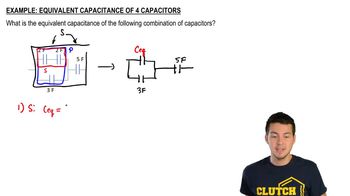
Equivalent capacitance is a single capacitance value that can replace a combination of capacitors in a circuit without changing the overall behavior. It simplifies circuit analysis by allowing the use of a single capacitor to represent multiple capacitors. Calculating the equivalent capacitance is vital for determining how the capacitors interact and how they affect the overall circuit performance.
Recommended video:
Guided course
Find Equivalent Capacitance #1
Related Practice
Textbook Question
173
views
Textbook Question
What is the capacitance of the two metal spheres shown in FIGURE EX26.22?
230
views
Textbook Question
50 pJ of energy is stored in a 2.0 cm×2.0 cm×2.0 cm region of uniform electric field. What is the electric field strength?
67
views
Textbook Question
A 6 μF capacitor, a 10 μF capacitor, and a 16 μF capacitor are connected in series. What is their equivalent capacitance?
283
views
Textbook Question
A switch that connects a battery to a 10 μF capacitor is closed. Several seconds later you find that the capacitor plates are charged to ±30 μC. What is the emf of the battery?
1661
views
Textbook Question
You need a capacitance of 50 μF, but you don't happen to have a 50 μF capacitor. You do have a 75 μF capacitor. What additional capacitor do you need to produce a total capacitance of 50 μF? Should you join the two capacitors in parallel or in series?
169
views