Ch 17: Superposition
Knight Calc - Physics for Scientists and Engineers 5th Edition
Knight Calc5th EditionPhysics for Scientists and EngineersISBN: 9780137344796Not the one you use?Change textbook
Chapter 17, Problem 6

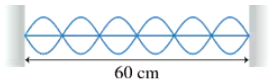
FIGURE EX17.6 shows a standing wave oscillating at 100 Hz on a string. What is the wave speed?

Verified step by step guidance
1
Step 1: Identify the frequency of the standing wave. The problem states that the wave oscillates at 100 Hz, so the frequency (f) is 100 Hz.
Step 2: Analyze the image to determine the wavelength (λ). The image shows a standing wave with 3 full wavelengths fitting into the string's length of 72 cm. Divide the total length of the string by the number of wavelengths to find the wavelength: λ = (72 cm) / 3.
Step 3: Convert the wavelength from centimeters to meters for consistency in SI units. Since 1 cm = 0.01 m, multiply the wavelength in cm by 0.01 to get the wavelength in meters.
Step 4: Use the wave speed formula: v = f × λ, where v is the wave speed, f is the frequency, and λ is the wavelength. Substitute the values of f and λ into the formula.
Step 5: Perform the multiplication to calculate the wave speed. Ensure the units are consistent (meters per second for wave speed).

Verified video answer for a similar problem:

This video solution was recommended by our tutors as helpful for the problem above.
Video duration:
1m
Was this helpful?

Key Concepts

Here are the essential concepts you must grasp in order to answer the question correctly.

Wave Speed

Wave speed is the distance a wave travels per unit of time. It can be calculated using the formula v = fλ, where v is the wave speed, f is the frequency, and λ (lambda) is the wavelength. In this case, knowing the frequency (100 Hz) allows us to find the wave speed once we determine the wavelength from the standing wave pattern.
Recommended video:
Guided course
07:19
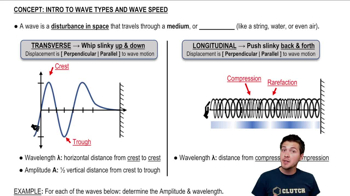
Intro to Waves and Wave Speed

Standing Waves

A standing wave is formed when two waves of the same frequency and amplitude travel in opposite directions and interfere with each other. This results in nodes (points of no displacement) and antinodes (points of maximum displacement) along the medium. The length of the string and the number of antinodes can help determine the wavelength of the standing wave.
Recommended video:
Guided course
07:58
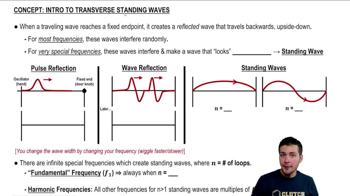
Intro to Transverse Standing Waves

Wavelength

Wavelength is the distance between successive crests (or troughs) of a wave. For standing waves, the wavelength can be determined by the length of the string and the number of loops formed. In this case, the total length of the string (72 cm) corresponds to a certain number of wavelengths, which is essential for calculating the wave speed.
Recommended video:
Guided course
05:42
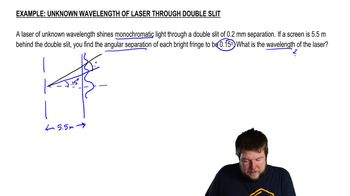
Unknown Wavelength of Laser through Double Slit