Ch 10: Interactions and Potential Energy
Knight Calc - Physics for Scientists and Engineers 5th Edition
Knight Calc5th EditionPhysics for Scientists and EngineersISBN: 9780137344796Not the one you use?Change textbook
Chapter 10, Problem 2

A system consists of interacting objects A and B, each exerting a constant 3.0 N pull on the other. What is ∆U for the system if A moves 1.0 m toward B while B moves 2.0 m toward A?

Verified step by step guidance
1
Step 1: Understand the problem. The system consists of two objects, A and B, exerting constant forces on each other. The problem asks for the change in potential energy (ΔU) of the system as the objects move toward each other. Recall that potential energy in a system involving forces depends on the displacement of the objects and the magnitude of the force.
Step 2: Recall the formula for work done by a force, which is related to the change in potential energy. Work done (W) is given by: W=Fdcosθ, where F is the force, d is the displacement, and θ is the angle between the force and displacement vectors. In this case, the force and displacement are aligned, so θ = 0° and cos(θ) = 1.
Step 3: Calculate the total displacement of the system. Object A moves 1.0 m toward B, and object B moves 2.0 m toward A. The total displacement is the sum of these distances: d=1.0+2.0.
Step 4: Use the formula for work done to calculate the change in potential energy (ΔU). Since the force exerted by each object is constant at 3.0 N, and the total displacement is calculated in the previous step, substitute these values into the formula: ΔU=Fd. Remember that ΔU is equal to the work done by the force.
Step 5: Interpret the result. The change in potential energy (ΔU) represents the energy transferred due to the work done by the forces as the objects move closer together. Ensure the units are consistent (N·m or Joules) and verify the calculation steps.

Verified video answer for a similar problem:

This video solution was recommended by our tutors as helpful for the problem above.
Video duration:
1m
Was this helpful?

Key Concepts

Here are the essential concepts you must grasp in order to answer the question correctly.

Work and Energy

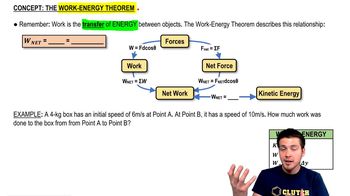
In physics, work is defined as the energy transferred to or from an object via the application of force along a displacement. The work done on an object can change its kinetic or potential energy. In this scenario, the forces exerted by objects A and B result in work being done as they move toward each other, which affects the system's potential energy.
Recommended video:
Guided course
04:10
The Work-Energy Theorem

Potential Energy (U)

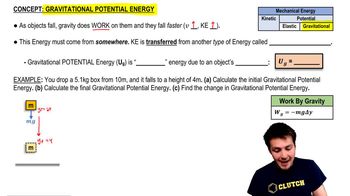
Potential energy is the stored energy in a system due to the position of its components. In this case, as objects A and B move closer together, the potential energy of the system changes. The change in potential energy (delta U) can be calculated based on the work done by the forces acting between the objects as they move.
Recommended video:
Guided course
06:35
Gravitational Potential Energy

Conservative Forces

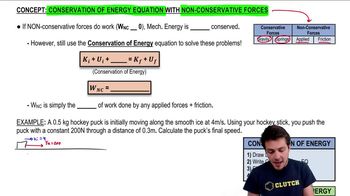
Conservative forces are forces that do not dissipate energy and for which the work done is path-independent. The gravitational and elastic forces are common examples. In this problem, the constant 3.0 N pull between A and B can be considered a conservative force, allowing us to analyze the energy changes in the system without accounting for energy loss.
Recommended video:
Guided course
06:43
Energy Conservation with Non-Conservative Forces