Ch 03: Vectors and Coordinate Systems
Knight Calc - Physics for Scientists and Engineers 5th Edition
Knight Calc5th EditionPhysics for Scientists and EngineersISBN: 9780137344796Not the one you use?Change textbook
Chapter 3, Problem 19

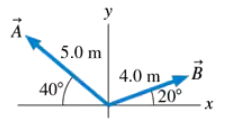
FIGURE EX3.19 shows vectors A and B. What is C = A + B? Write your answer in component form using unit vectors.

Verified step by step guidance
1
Step 1: Analyze the given vectors A and B in the problem. Identify their components along the x-axis and y-axis. For example, vector A might be expressed as \( A = A_x \hat{i} + A_y \hat{j} \), and vector B might be expressed as \( B = B_x \hat{i} + B_y \hat{j} \).
Step 2: To find the resultant vector \( C \), use the vector addition formula: \( C = A + B \). This means adding the corresponding components of vectors A and B. Specifically, \( C_x = A_x + B_x \) and \( C_y = A_y + B_y \).
Step 3: Write the resultant vector \( C \) in component form using unit vectors. After calculating \( C_x \) and \( C_y \), express \( C \) as \( C = C_x \hat{i} + C_y \hat{j} \).
Step 4: Double-check the signs and values of the components to ensure accuracy. Pay attention to the direction of the vectors and whether the components are positive or negative based on the coordinate system.
Step 5: If needed, simplify the expression for \( C \) further, but keep it in component form using unit vectors \( \hat{i} \) and \( \hat{j} \). This is the final representation of the resultant vector.

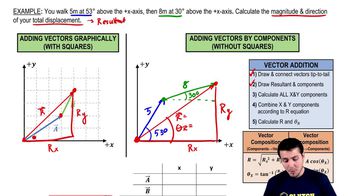
Verified video answer for a similar problem:

This video solution was recommended by our tutors as helpful for the problem above.
Video duration:
8m
Was this helpful?

Key Concepts

Here are the essential concepts you must grasp in order to answer the question correctly.

Vector Addition

Vector addition involves combining two or more vectors to produce a resultant vector. This is done by adding the corresponding components of the vectors. For example, if vector A has components (Ax, Ay) and vector B has components (Bx, By), the resultant vector C can be expressed as C = (Ax + Bx, Ay + By).
Recommended video:
Guided course
07:30
Vector Addition By Components

Unit Vectors

Unit vectors are vectors that have a magnitude of one and are used to indicate direction. In a Cartesian coordinate system, the standard unit vectors are i (for the x-direction) and j (for the y-direction). Any vector can be expressed in terms of unit vectors, allowing for a clear representation of its direction and magnitude.
Recommended video:

Component Form

Component form refers to expressing a vector in terms of its horizontal and vertical components. For a vector C, this is typically written as C = Cx i + Cy j, where Cx and Cy are the components along the x and y axes, respectively. This form is essential for performing calculations involving vectors, such as addition or scalar multiplication.
Recommended video:
Guided course
07:30
Vector Addition By Components