
Ch 31: Electromagnetic Fields and Waves
Knight Calc - Physics for Scientists and Engineers 5th Edition
Knight Calc5th EditionPhysics for Scientists and EngineersISBN: 9780137344796Not the one you use?Change textbook
Chapter 31, Problem 66a

Consider current I passing through a resistor of radius r, length L, and resistance R. Determine the electric and magnetic fields at the surface of the resistor. Assume that the electric field is uniform throughout, including at the surface.

Verified step by step guidance
1
Step 1: Start by recalling Ohm's Law, which relates the electric field (E), current (I), and resistance (R). The electric field inside the resistor can be expressed as: E = VL, where V is the voltage across the resistor and L is its length. Using Ohm's Law, V = IR, substitute V into the equation for E.
Step 2: Substitute the resistance R in terms of the material's resistivity (ρ), length (L), and cross-sectional area (A). The resistance is given by: R = ρA, where A = πr2. Substitute this expression for R into the equation for E.
Step 3: To find the magnetic field (B) at the surface of the resistor, use Ampere's Law. For a cylindrical resistor, the magnetic field at the surface is due to the current I passing through it. Ampere's Law states: Bdl = μ0I, where μ0 is the permeability of free space. For a circular path at the surface of the resistor, the magnetic field is uniform, and the path length is the circumference of the resistor: l = 2πr.
Step 4: Solve for the magnetic field B using Ampere's Law. Rearrange the equation to get: B = μ0I2πr. This gives the magnetic field at the surface of the resistor in terms of the current I and the radius r.
Step 5: Combine the results. The electric field E is uniform and can be expressed in terms of the current I, resistivity ρ, length L, and radius r. The magnetic field B at the surface is determined using Ampere's Law and depends on the current I and radius r. These fields are orthogonal to each other, with E along the length of the resistor and B encircling the resistor.

Verified video answer for a similar problem:

This video solution was recommended by our tutors as helpful for the problem above.
Was this helpful?

Key Concepts

Here are the essential concepts you must grasp in order to answer the question correctly.

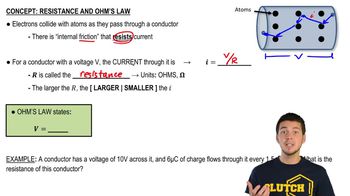
Ohm's Law

Ohm's Law states that the current (I) flowing through a conductor between two points is directly proportional to the voltage (V) across the two points and inversely proportional to the resistance (R) of the conductor. This relationship is expressed mathematically as V = IR. Understanding this law is essential for analyzing how current interacts with resistance in the resistor.
Recommended video:
Guided course
03:07
Resistance and Ohm's Law

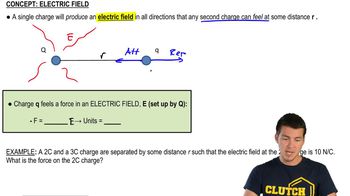
Electric Field

An electric field is a region around a charged object where other charged objects experience a force. The electric field (E) can be defined as the force (F) per unit charge (q), given by E = F/q. In the context of the resistor, the electric field is uniform and drives the flow of current through the material, influencing how charges move within the resistor.
Recommended video:
Guided course
03:16
Intro to Electric Fields

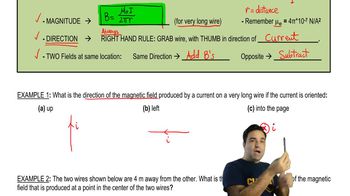
Magnetic Field due to Current

A magnetic field is generated around a conductor when an electric current flows through it. According to Ampère's Law, the magnetic field (B) around a long straight conductor is proportional to the current (I) and inversely proportional to the distance (r) from the conductor, expressed as B = (μ₀I)/(2πr) in free space. This concept is crucial for understanding the magnetic effects produced by the current in the resistor.
Recommended video:
Guided course
12:33
Magnetic Field Produced by Straight Currents