
A 50 kg ice skater is gliding along the ice, heading due north at 4.0 m/s. The ice has a small coefficient of static friction, to prevent the skater from slipping sideways, but μk = 0. Suddenly, a wind from the northeast exerts a force of 4.0 N on the skater. What is the minimum value of μs that allows her to continue moving straight north?
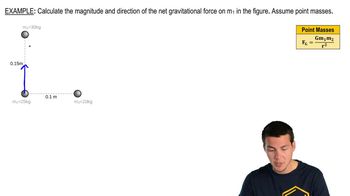
The gravitational attraction between two objects with masses mA and mB, separated by distance 𝓍, is F = GmAmB/𝓍², where G is the gravitational constant. If one mass is much greater than the other, the larger mass stays essentially at rest while the smaller mass moves toward it. Suppose a 1.5 x 10¹³ kg comet is passing the orbit of Mars, heading straight for the sun at a speed of 3.5 x 10⁴ m/s. What will its speed be when it crosses the orbit of Mercury? Astronomical data are given in the tables at the back of the book, and G = 6.67 x 10⁻¹¹ Nm²/kg².
Verified step by step guidance
Verified video answer for a similar problem:
Key Concepts
Gravitational Force
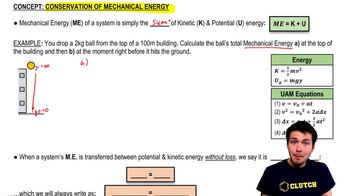
Conservation of Energy
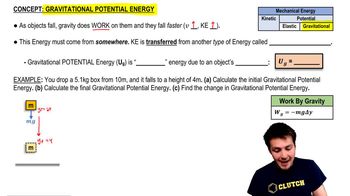
Kinetic and Potential Energy
A 50 g rock is placed in a slingshot and the rubber band is stretched. The magnitude of the force of the rubber band on the rock is shown by the graph in FIGURE P9.56. The rubber band is stretched 30 cm and then released. What is the speed of the rock?
A red ball has a mass of 250 g. A constant force pushes the red ball horizontally and launches it at a speed of 15 m/s. The same force pushes a green ball through the same distance, launching it at 25 m/s. What is the mass of the green ball?
A 30 g mass is attached to one end of a 10-cm-long spring. The other end of the spring is connected to a frictionless pivot on a frictionless, horizontal surface. Spinning the mass around in a circle at 90 rpm causes the spring to stretch to a length of 12 cm. What is the value of the spring constant?
A 50 kg ice skater is gliding along the ice, heading due north at 4.0 m/s. The ice has a small coefficient of static friction, to prevent the skater from slipping sideways, but μk = 0. Suddenly, a wind from the northeast exerts a force of 4.0 N on the skater. Use work and energy to find the skater's speed after gliding 100 m in this wind.
A 737-800 jet airliner has twin engines, each with 105 kN thrust. A 78,000 kg jet reaches a takeoff speed of 70 m/s in a distance of 1100 m. What is the increase in thermal energy due to rolling friction and air drag?
