
Textbook Question
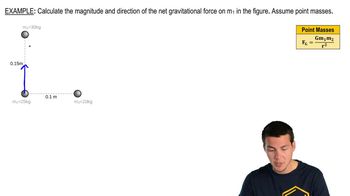
Two Jupiter-size planets are released from rest 1.0 x 10¹¹ m apart. What are their speeds as they crash together?
1333
views

 Verified step by step guidance
 08:25
08:25
 05:41
05:41 04:45
04:45Two Jupiter-size planets are released from rest 1.0 x 10¹¹ m apart. What are their speeds as they crash together?
FIGURE CP13.71 shows a particle of mass m at distance 𝓍 from the center of a very thin cylinder of mass M and length L. The particle is outside the cylinder, so 𝓍 > L/2 . Calculate the gravitational potential energy of these two masses.
A 55,000 kg space capsule is in a 28,000-km-diameter circular orbit around the moon. A brief but intense firing of its engine in the forward direction suddenly decreases its speed by 50%. This causes the space capsule to go into an elliptical orbit. What are the space capsule’s (a) maximum and (b) minimum distances from the center of the moon in its new orbit? Hint: You will need to use two conservation laws.
A satellite in a circular orbit of radius r has period T. A satellite in a nearby orbit with radius r + Δr, where Δr ≪ r, has the very slightly different period T + ΔT. Show that ΔT/T = (3/2) (Δr/r)
Let’s look in more detail at how a satellite is moved from one circular orbit to another. FIGURE CP13.70 shows two circular orbits, of radii r1 and r2, and an elliptical orbit that connects them. Points 1 and 2 are at the ends of the semimajor axis of the ellipse. Consider a 1000 kg communications satellite that needs to be boosted from an orbit 300 km above the earth to a geosynchronous orbit 35,900 km above the earth. Find the velocity v'1 on the inner circular orbit and the velocity v'1 at the low point on the elliptical orbit that spans the two circular orbits.
Let's look in more detail at how a satellite is moved from one circular orbit to another. FIGURE CP13.70 shows two circular orbits, of radii r1 and r2, and an elliptical orbit that connects them. Points 1 and 2 are at the ends of the semimajor axis of the ellipse. How much work must the rocket motor do to transfer the satellite from the circular orbit to the elliptical orbit?