
Ch 12: Rotation of a Rigid Body
Knight Calc - Physics for Scientists and Engineers 5th Edition
Knight Calc5th EditionPhysics for Scientists and EngineersISBN: 9780137344796Not the one you use?Change textbook
Chapter 12, Problem 69

A 750 g disk and a 760 g ring, both 15 cm in diameter, are rolling along a horizontal surface at 1.5 m/s when they encounter a 15° slope. How far up the slope does each travel before rolling back down?

Verified step by step guidance
1
Convert the masses of the disk and ring from grams to kilograms: \( m_{\text{disk}} = 0.750 \; \text{kg} \) and \( m_{\text{ring}} = 0.760 \; \text{kg} \). Also, convert the diameter to radius: \( r = \frac{15}{2} \; \text{cm} = 0.075 \; \text{m} \).
Determine the total energy of each object at the base of the slope. The total energy is the sum of translational kinetic energy and rotational kinetic energy: \( E_{\text{total}} = \frac{1}{2} m v^2 + \frac{1}{2} I \omega^2 \), where \( I \) is the moment of inertia and \( \omega = \frac{v}{r} \) is the angular velocity.
Substitute the moments of inertia for the disk \( I_{\text{disk}} = \frac{1}{2} m r^2 \) and the ring \( I_{\text{ring}} = m r^2 \) into the energy equation. Simplify to find the total energy for each object in terms of \( m \), \( v \), and \( r \).
At the highest point on the slope, all the kinetic energy is converted into gravitational potential energy: \( E_{\text{total}} = m g h \), where \( h \) is the height reached. Use the energy conservation principle to solve for \( h \): \( h = \frac{E_{\text{total}}}{m g} \).
Relate the height \( h \) to the distance traveled up the slope \( d \) using the slope angle \( \theta \): \( h = d \sin(\theta) \). Solve for \( d \): \( d = \frac{h}{\sin(\theta)} \). Substitute the values for \( \theta = 15^\circ \), \( g = 9.8 \; \text{m/s}^2 \), and the calculated \( h \) for each object to find the distance traveled up the slope.

Verified video answer for a similar problem:

This video solution was recommended by our tutors as helpful for the problem above.
Video duration:
18m
Was this helpful?

Key Concepts

Here are the essential concepts you must grasp in order to answer the question correctly.

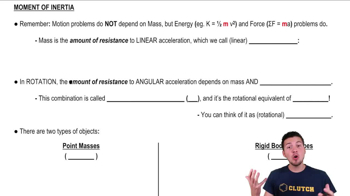
Moment of Inertia

Moment of inertia is a measure of an object's resistance to changes in its rotational motion. It depends on the mass distribution relative to the axis of rotation. For a disk and a ring, the moment of inertia is calculated differently: the disk has a moment of inertia of (1/2)mr², while the ring has mr², where m is mass and r is the radius. Understanding these differences is crucial for analyzing their rolling motion.
Recommended video:
Guided course
11:47
Intro to Moment of Inertia

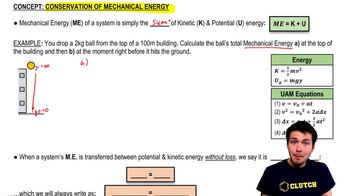
Conservation of Energy

The principle of conservation of energy states that energy cannot be created or destroyed, only transformed from one form to another. In this scenario, the kinetic energy of the rolling objects will convert into gravitational potential energy as they ascend the slope. The total mechanical energy at the bottom of the slope must equal the total mechanical energy at the highest point reached before rolling back down.
Recommended video:
Guided course
06:24
Conservation Of Mechanical Energy

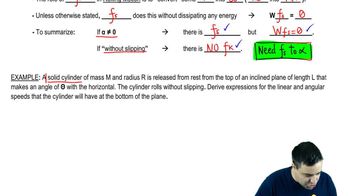
Rolling Motion

Rolling motion involves both translational and rotational motion, where an object rolls without slipping. The velocity of the center of mass and the angular velocity are related through the radius of the object. For the disk and ring, the rolling motion affects how they convert kinetic energy into potential energy as they climb the slope, influencing the distance each travels before rolling back down.
Recommended video:
Guided course
12:26
Conservation of Energy in Rolling Motion
Related Practice
Textbook Question

A solid spherical marble shot up a frictionless 15° slope rolls 2.50 m to its highest point. If the marble is shot with the same speed up a slightly rough 15° slope, it rolls only 2.30 m. What is the coefficient of rolling friction on the second slope?

1640
views
Textbook Question

A 30-cm-diameter, 1.2 kg solid turntable rotates on a 1.2-cm-diameter, 450 g shaft at a constant 33 rpm. When you hit the stop switch, a brake pad presses against the shaft and brings the turntable to a halt in 15 seconds. How much friction force does the brake pad apply to the shaft?

1789
views
Textbook Question

The 5.0 kg, 60-cm-diameter disk in FIGURE P12.71 rotates on an axle passing through one edge. The axle is parallel to the floor. The cylinder is held with the center of mass at the same height as the axle, then released. What is the cylinder's angular velocity when it is directly below the axle?

437
views
Textbook Question

Your engineering team has been assigned the task of measuring the properties of a new jet-engine turbine. You've previously determined that the turbine's moment of inertia is 2.6 kg m2. The next job is to measure the frictional torque of the bearings. Your plan is to run the turbine up to a predetermined rotation speed, cut the power, and time how long it takes the turbine to reduce its rotation speed by 50%. Your data are given in the table. Draw an appropriate graph of the data and, from the slope of the best-fit line, determine the frictional torque.

1333
views
Textbook Question

A long, thin rod of mass M and length L is standing straight up on a table. Its lower end rotates on a frictionless pivot. A very slight push causes the rod to fall over. As it hits the table, what are the angular velocity

1863
views
Textbook Question

Flywheels are large, massive wheels used to store energy. They can be spun up slowly, then the wheel's energy can be released quickly to accomplish a task that demands high power. An industrial flywheel has a 1.5 m diameter and a mass of 250 kg. Its maximum angular velocity is 1200 rpm. How much energy is stored in the flywheel?

2047
views