Ch 32: AC Circuits
Knight Calc - Physics for Scientists and Engineers 5th Edition
Knight Calc5th EditionPhysics for Scientists and EngineersISBN: 9780137344796Not the one you use?Change textbook
Chapter 32, Problem 64

A generator consists of a 12-cm by 16-cm rectangular loop with 500 turns of wire spinning at 60 Hz in a 25 mT uniform magnetic field. The generator output is connected to a series RC circuit consisting of a 120 Ω resistor and a 35 μF capacitor. What is the average power delivered to the circuit?

Verified step by step guidance
1
Calculate the area of the rectangular loop using the formula \( A = l \times w \), where \( l = 12 \ \text{cm} = 0.12 \ \text{m} \) and \( w = 16 \ \text{cm} = 0.16 \ \text{m} \).
Determine the maximum emf (electromotive force) generated by the loop using the formula \( \mathcal{E}_{\text{max}} = N \cdot B \cdot A \cdot \omega \), where \( N = 500 \) (number of turns), \( B = 25 \ \text{mT} = 0.025 \ \text{T} \), \( A \) is the area calculated in step 1, and \( \omega = 2 \pi f \) with \( f = 60 \ \text{Hz} \).
Find the root mean square (RMS) value of the emf using the relationship \( \mathcal{E}_{\text{rms}} = \frac{\mathcal{E}_{\text{max}}}{\sqrt{2}} \).
Calculate the total impedance of the RC circuit using the formula \( Z = \sqrt{R^2 + \left( \frac{1}{\omega C} \right)^2} \), where \( R = 120 \ \Omega \), \( \omega = 2 \pi f \), and \( C = 35 \ \mu\text{F} = 35 \times 10^{-6} \ \text{F} \).
Determine the average power delivered to the circuit using the formula \( P_{\text{avg}} = \frac{\mathcal{E}_{\text{rms}}^2}{Z} \).

Verified video answer for a similar problem:

This video solution was recommended by our tutors as helpful for the problem above.
Video duration:
10m
Was this helpful?

Key Concepts

Here are the essential concepts you must grasp in order to answer the question correctly.

Electromagnetic Induction

Electromagnetic induction is the process by which a changing magnetic field within a closed loop induces an electromotive force (EMF) in the wire. This principle, described by Faraday's Law, states that the induced EMF is proportional to the rate of change of magnetic flux through the loop. In this question, the spinning loop in a magnetic field generates an alternating current due to its motion.
Recommended video:
Guided course
05:42
Introduction to Induction

AC Circuit Analysis

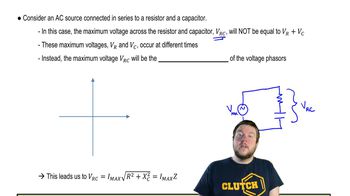
AC circuit analysis involves understanding how alternating current (AC) behaves in circuits, particularly with components like resistors and capacitors. The impedance in an RC circuit combines resistance and reactance, affecting the current and voltage relationship. The average power delivered to the circuit can be calculated using the root mean square (RMS) values of voltage and current, along with the phase angle between them.
Recommended video:
Guided course
08:40
Impedance in AC Circuits

Power in AC Circuits

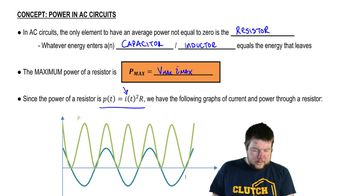
In AC circuits, the average power delivered is calculated using the formula P = VIcos(φ), where V is the RMS voltage, I is the RMS current, and φ is the phase angle between the voltage and current. The presence of reactive components like capacitors can cause the current to lag or lead the voltage, affecting the power factor. Understanding this concept is crucial for determining how much power is effectively used in the circuit.
Recommended video:
Guided course
05:37
Power in AC Circuits
Related Practice
Textbook Question

A television channel is assigned the frequency range from 54 MHz to 60 MHz. A series RLC tuning circuit in a TV receiver resonates in the middle of this frequency range. The circuit uses a 16 pF capacitor. What is the value of the inductor?

1860
views
Textbook Question

A motor attached to a 120 V/60 Hz power line draws an 8.0 A current. Its average energy dissipation is 800 W. What is the rms resistor voltage?

158
views
Textbook Question

Commercial electricity is generated and transmitted as three-phase electricity. Instead of a single emf ε = ε0 cos ωt, three separate wires carry currents for the emfs ε1 = ε0 cos ωt, ε2 = ε0 cos(ωt+120°), and ε3 = ε0 cos(ωt−120°). This is why the long-distance transmission lines you see in the countryside have three parallel wires, as do many distribution lines within a city. Show that the potential difference between any two of the phases has the rms value 3–√ εrms, where εrms is the familiar single-phase rms voltage. Evaluate this potential difference for εrms = 120 V. Some high-power home appliances, especially electric clothes dryers and hot-water heaters, are designed to operate between two of the phases rather than between one phase and neutral. Heavy-duty industrial motors are designed to operate from all three phases, but full three-phase power is rare in residential or office use.

111
views
Textbook Question

Commercial electricity is generated and transmitted as three-phase electricity. Instead of a single emf, three separate wires carry currents for the emfs ε1 = ε0 cos ωt, ε2 = ε0 cos(ωt +120°), and ε3 = ε0 cos(ωt−120°) over three parallel wires, each of which supplies one-third of the power. This is why the long-distance transmission lines you see in the countryside have three wires. Suppose the transmission lines into a city supply a total of 450 MW of electric power, a realistic value. What would be the rms current in each wire if the transmission voltage were ε0 = 120 V rms?

1691
views
Textbook Question

You're the operator of a 15,000 V rms, 60 Hz electrical substation. When you get to work one day, you see that the station is delivering 6.0 MW of power with a power factor of 0.90. What is the rms current leaving the station?

144
views
Textbook Question

Commercial electricity is generated and transmitted as three-phase electricity. Instead of a single emf, three separate wires carry currents for the emfs ε1 = ε0 cos ωt, ε2 = ε0 cos(ωt +120°), and ε3 = ε0 cos(ωt−120°) over three parallel wires, each of which supplies one-third of the power. This is why the long-distance transmission lines you see in the countryside have three wires. Suppose the transmission lines into a city supply a total of 450 MW of electric power, a realistic value. In fact, transformers are used to step the transmission-line voltage up to 500 kV rms. What is the current in each wire?

1690
views