Ch 22: Electric Charges and Forces
Knight Calc - Physics for Scientists and Engineers 5th Edition
Knight Calc5th EditionPhysics for Scientists and EngineersISBN: 9780137344796Not the one you use?Change textbook
Chapter 22, Problem 60

You have a lightweight spring whose unstretched length is 4.0 cm. First, you attach one end of the spring to the ceiling and hang a 1.0 g mass from it. This stretches the spring to a length of 5.0 cm. You then attach two small plastic beads to the opposite ends of the spring, lay the spring on a frictionless table, and give each plastic bead the same charge. This stretches the spring to a length of 4.5 cm. What is the magnitude of the charge (in nC) on each bead?

Verified step by step guidance
1
Step 1: Identify the forces acting on the spring in each scenario. In the first case, the spring is stretched due to the gravitational force exerted by the 1.0 g mass. In the second case, the spring is stretched due to the electrostatic force between the two charged beads.
Step 2: Use Hooke's Law to relate the force and the spring's extension. Hooke's Law is given by \( F = k \Delta x \), where \( F \) is the force, \( k \) is the spring constant, and \( \Delta x \) is the change in length of the spring from its unstretched length.
Step 3: Calculate the spring constant \( k \) using the first scenario. The force due to gravity is \( F = mg \), where \( m \) is the mass (1.0 g = 0.001 kg) and \( g \) is the acceleration due to gravity (9.8 m/s²). The extension \( \Delta x \) is the difference between the stretched length (5.0 cm = 0.05 m) and the unstretched length (4.0 cm = 0.04 m). Substitute these values into \( k = \frac{F}{\Delta x} \).
Step 4: Use the spring constant \( k \) calculated in Step 3 to analyze the second scenario. The force stretching the spring in this case is the electrostatic force between the two charged beads, given by Coulomb's Law: \( F = \frac{k_e q^2}{r^2} \), where \( k_e \) is Coulomb's constant (\( 8.99 \times 10^9 \, \mathrm{N \cdot m^2 / C^2} \)), \( q \) is the charge on each bead, and \( r \) is the distance between the beads (equal to the stretched length of the spring, 4.5 cm = 0.045 m).
Step 5: Equate the electrostatic force \( F \) from Coulomb's Law to the spring force \( F = k \Delta x \), where \( \Delta x \) is the extension of the spring in the second scenario (4.5 cm - 4.0 cm = 0.005 m). Solve for \( q \) (the charge on each bead) by rearranging the equation \( \frac{k_e q^2}{r^2} = k \Delta x \).

Verified video answer for a similar problem:

This video solution was recommended by our tutors as helpful for the problem above.
Video duration:
7m
Was this helpful?

Key Concepts

Here are the essential concepts you must grasp in order to answer the question correctly.

Hooke's Law

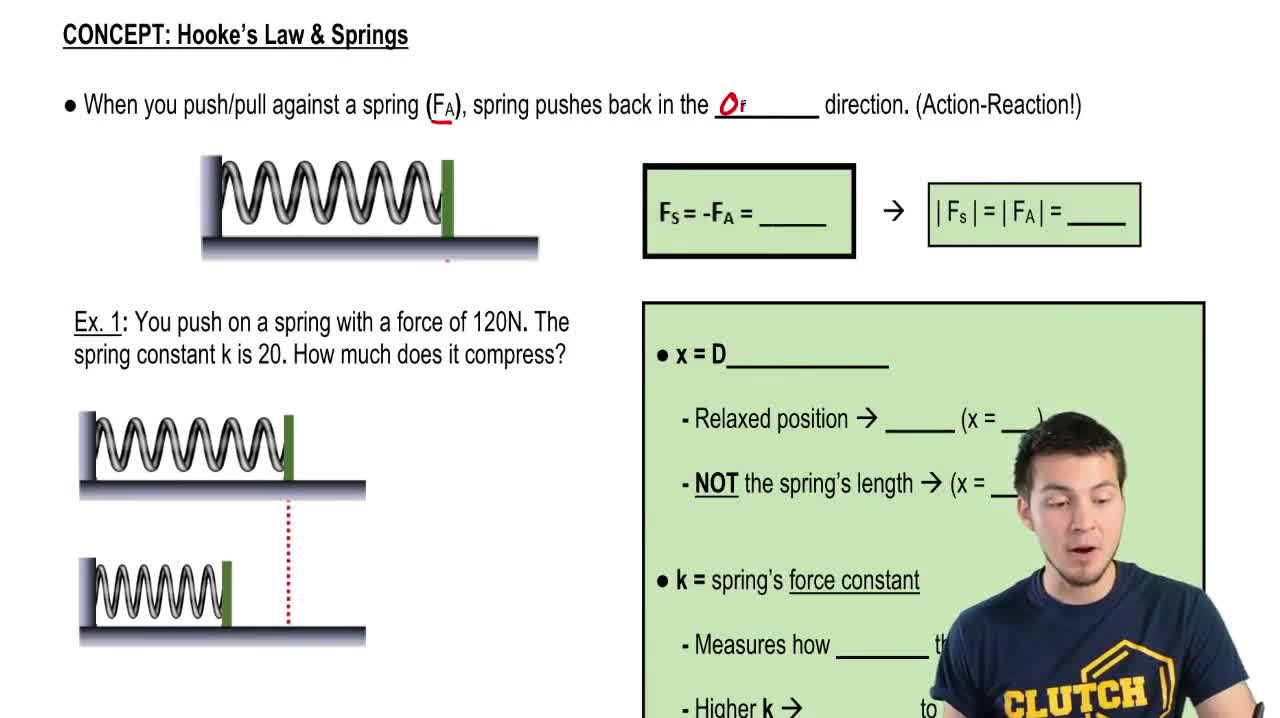
Hooke's Law states that the force exerted by a spring is directly proportional to its extension or compression from its natural length, expressed as F = kx, where F is the force, k is the spring constant, and x is the displacement from the equilibrium position. This principle is essential for understanding how the spring behaves when weights are added or when forces are applied.
Recommended video:
Guided course
05:27
Spring Force (Hooke's Law)

Electrostatic Force

The electrostatic force is the force between charged objects, described by Coulomb's Law, which states that the force is proportional to the product of the magnitudes of the charges and inversely proportional to the square of the distance between them. This concept is crucial for analyzing the interaction between the charged beads and how it affects the spring's extension.
Recommended video:
Guided course
06:48
Intro to Centripetal Forces

Equilibrium Condition

The equilibrium condition occurs when the net force acting on an object is zero, meaning all forces balance out. In this scenario, the gravitational force acting on the mass and the spring force must equal the electrostatic force between the charged beads, allowing us to set up equations to solve for the unknown charge on the beads.
Recommended video:
Guided course
10:13
Torque & Equilibrium
Related Practice
Textbook Question

In a simple model of the hydrogen atom, the electron moves in a circular orbit of radius 0.053 nm around a stationary proton. How many revolutions per second does the electron make?

2131
views
1
comments

Textbook Question

Two equal point charges 2.5 cm apart, both initially neutral, are being charged at the rate of 5.0 nC/s. At what rate (N/s) is the force between them increasing 1.0 s after charging begins?

279
views
Textbook Question

An electric dipole consists of two opposite charges ±q±q separated by a small distance ss. The product p=qsp=qs is called the dipole moment. Figure P22.6122.61 shows an electric dipole perpendicular to an electric field EE. Find an expression in terms of pp and EE for the magnitude of the torque that the electric field exerts on the dipole.

2310
views
Textbook Question

You have two small, 2.0 g balls that have been given equal but opposite charges, but you don't know the magnitude of the charge. To find out, you place the balls distance apart on a slippery horizontal surface, release them, and use a motion detector to measure the initial acceleration of one of the balls toward the other. After repeating this for several different separation distances, your data are shown below. Use an appropriate graph of the data to determine the magnitude of the charge.

1609
views
Textbook Question

The identical small spheres shown in FIGURE P22.64 are charged to +100 nC and −100 nC. They hang as shown in a 100,000 N/C electric field. What is the mass of each sphere?

3382
views
Textbook Question

A 10.0 nC charge is located at position (x, y)=(1.0 cm, 2.0 cm). At what (x, y) position(s) is the electric field (21,600i^28,800j^)(21,600\(\hat{i}\)-28,800\(\hat{j}\)) N/C?

1892
views