
Ch 08: Dynamics II: Motion in a Plane
Knight Calc - Physics for Scientists and Engineers 5th Edition
Knight Calc5th EditionPhysics for Scientists and EngineersISBN: 9780137344796Not the one you use?Change textbook
Chapter 8, Problem 9

Suppose the moon were held in its orbit not by gravity but by a massless cable attached to the center of the earth. What would be the tension in the cable? Use the table of astronomical data inside the back cover of the book.

Verified step by step guidance
1
Step 1: Identify the forces acting on the moon. In this scenario, the tension in the cable is the force providing the centripetal force required to keep the moon in its circular orbit around the Earth. Gravity is not contributing to the centripetal force since the problem specifies that the moon is held by a massless cable.
Step 2: Write the formula for centripetal force. The centripetal force is given by \( F_c = \frac{m v^2}{r} \), where \( m \) is the mass of the moon, \( v \) is its orbital velocity, and \( r \) is the radius of its orbit (distance from the center of the Earth to the moon).
Step 3: Express the orbital velocity \( v \) in terms of the orbital period \( T \). The moon's orbital velocity can be calculated using \( v = \frac{2 \pi r}{T} \), where \( T \) is the orbital period of the moon.
Step 4: Substitute \( v = \frac{2 \pi r}{T} \) into the centripetal force formula. This gives \( F_c = \frac{m (2 \pi r / T)^2}{r} \). Simplify the expression to \( F_c = \frac{4 \pi^2 m r}{T^2} \).
Step 5: Use the astronomical data provided in the table (mass of the moon \( m \), orbital radius \( r \), and orbital period \( T \)) to calculate the tension in the cable. Plug these values into the formula \( F_c = \frac{4 \pi^2 m r}{T^2} \) to determine the tension.

Verified video answer for a similar problem:

This video solution was recommended by our tutors as helpful for the problem above.
Video duration:
3m
Was this helpful?

Key Concepts

Here are the essential concepts you must grasp in order to answer the question correctly.

Centripetal Force

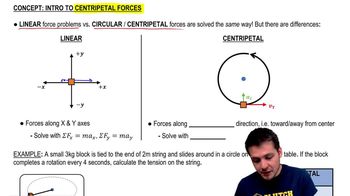
Centripetal force is the net force required to keep an object moving in a circular path, directed towards the center of the circle. In this scenario, the tension in the cable would act as the centripetal force necessary to maintain the moon's circular orbit around the Earth. The formula for centripetal force is F = mv²/r, where m is the mass of the moon, v is its orbital velocity, and r is the radius of the orbit.
Recommended video:
Guided course
06:48
Intro to Centripetal Forces

Gravitational Force

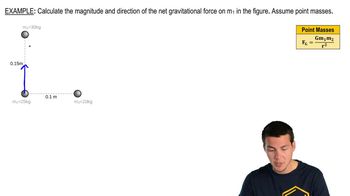
Gravitational force is the attractive force between two masses, described by Newton's law of universal gravitation. In the context of the moon's orbit, this force is what typically keeps the moon in its path around the Earth. However, in this hypothetical scenario, the gravitational force is replaced by the tension in the cable, which must equal the gravitational force for the moon to remain in orbit.
Recommended video:
Guided course
05:41
Gravitational Forces in 2D

Orbital Mechanics

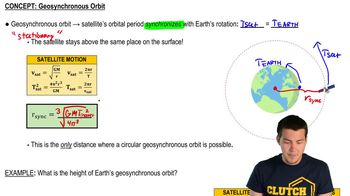
Orbital mechanics is the study of the motion of objects in space under the influence of gravitational forces. It encompasses the principles governing how celestial bodies move in their orbits. Understanding orbital mechanics is crucial for calculating the tension in the cable, as it involves analyzing the balance of forces acting on the moon and how they relate to its velocity and distance from the Earth.
Recommended video:
Guided course
04:45
Geosynchronous Orbits