Ch 17: Superposition
Knight Calc - Physics for Scientists and Engineers 5th Edition
Knight Calc5th EditionPhysics for Scientists and EngineersISBN: 9780137344796Not the one you use?Change textbook
Chapter 17, Problem 7a

FIGURE EX17.7 shows a standing wave on a string that is oscillating at 100 Hz. How many antinodes will there be if the frequency is increased to 200 Hz?

Verified step by step guidance
1
Step 1: Understand the relationship between the frequency of a standing wave and the number of antinodes. The number of antinodes is directly proportional to the frequency of the wave because increasing the frequency increases the number of oscillations per unit length of the string.
Step 2: Identify the current number of antinodes in the standing wave shown in FIGURE EX17.7. Count the antinodes present in the wave at the given frequency of 100 Hz.
Step 3: Recognize that doubling the frequency (from 100 Hz to 200 Hz) will double the number of antinodes, as the wavelength decreases proportionally to the increase in frequency. Use the formula for the wavelength of a standing wave: λ = v/f, where λ is the wavelength, v is the wave speed, and f is the frequency.
Step 4: Calculate the new number of antinodes by multiplying the current number of antinodes by the ratio of the new frequency to the original frequency. This ratio is 200/100 = 2, meaning the number of antinodes will double.
Step 5: Verify the result conceptually by considering the physical behavior of the string. At higher frequencies, the string oscillates more rapidly, creating more points of maximum displacement (antinodes) along its length.

Verified video answer for a similar problem:

This video solution was recommended by our tutors as helpful for the problem above.
Video duration:
6m
Was this helpful?

Key Concepts

Here are the essential concepts you must grasp in order to answer the question correctly.

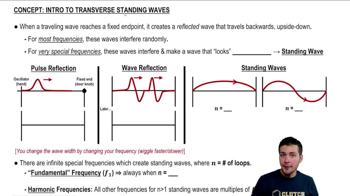
Standing Waves

Standing waves are formed when two waves of the same frequency and amplitude travel in opposite directions and interfere with each other. This results in specific points called nodes, where there is no movement, and antinodes, where the maximum displacement occurs. The pattern of these nodes and antinodes is determined by the wavelength and frequency of the waves.
Recommended video:
Guided course
07:58
Intro to Transverse Standing Waves

Frequency and Wavelength Relationship

The frequency of a wave is the number of oscillations that occur in a unit of time, while the wavelength is the distance between successive points of similar phase in the wave. According to the wave equation, increasing the frequency of a wave while keeping the speed constant results in a shorter wavelength. This relationship is crucial for understanding how changes in frequency affect the characteristics of standing waves.
Recommended video:
Guided course
05:08
Circumference, Period, and Frequency in UCM

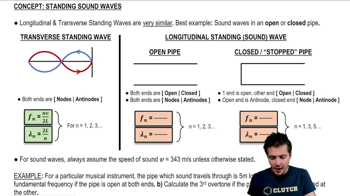
Antinodes in Standing Waves

Antinodes are points in a standing wave where the amplitude of oscillation is at its maximum. The number of antinodes in a standing wave is directly related to the frequency of the wave; as the frequency increases, the number of antinodes also increases. This is because higher frequencies correspond to shorter wavelengths, allowing more complete wave cycles to fit within the same length of string.
Recommended video:
Guided course
05:17
Standing Sound Waves