Ch 04: Kinematics in Two Dimensions
Knight Calc - Physics for Scientists and Engineers 5th Edition
Knight Calc5th EditionPhysics for Scientists and EngineersISBN: 9780137344796Not the one you use?Change textbook
Chapter 4, Problem 6b

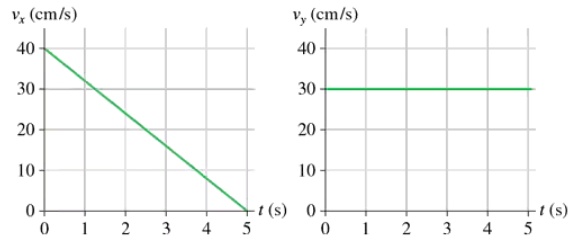
A rocket-powered hockey puck moves on a horizontal frictionless table. FIGURE EX4.6 shows graphs of vx and vy, the x- and y-components of the puck's velocity. The puck starts at the origin. How far from the origin is the puck at t = 5s?

Verified step by step guidance
1
Step 1: Analyze the graph for the x-component of velocity (Vx). The graph shows that Vx is constant at 3 cm/s over the time interval from t = 0 to t = 5 seconds. This indicates uniform motion in the x-direction.
Step 2: Use the formula for displacement in the x-direction under constant velocity: x = Vx * t. Here, Vx = 3 cm/s and t = 5 s.
Step 3: Analyze the graph for the y-component of velocity (Vy). Since the graph for Vy is not provided, we assume Vy = 0 cm/s, meaning there is no motion in the y-direction.
Step 4: Calculate the total displacement. Since there is no motion in the y-direction, the displacement in the y-direction is zero. The total displacement is therefore equal to the displacement in the x-direction.
Step 5: Combine the displacements in the x and y directions to find the distance from the origin. Use the Pythagorean theorem: distance = sqrt(x^2 + y^2). Substitute x and y values to find the distance.

Verified video answer for a similar problem:

This video solution was recommended by our tutors as helpful for the problem above.
Video duration:
11m
Was this helpful?

Key Concepts

Here are the essential concepts you must grasp in order to answer the question correctly.

Velocity Components

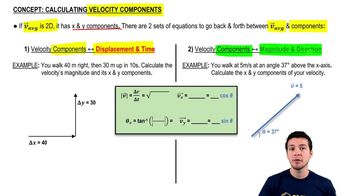
Velocity can be broken down into its components, typically in the x and y directions. In this scenario, the x-component of the velocity is constant, as indicated by the horizontal line in the graph. Understanding these components is crucial for determining the puck's position over time.
Recommended video:
Guided course
05:53
Calculating Velocity Components

Kinematics Equations

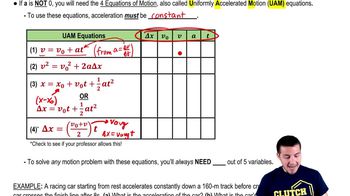
Kinematics equations describe the motion of objects under constant velocity or acceleration. For an object moving with constant velocity, the position can be calculated using the formula: position = initial position + velocity × time. This principle is essential for finding the puck's position at a given time.
Recommended video:
Guided course
08:25
Kinematics Equations

Frictionless Motion

In a frictionless environment, an object continues to move at a constant velocity unless acted upon by an external force. This simplifies the analysis of motion, as there are no opposing forces to consider. The hockey puck's motion on a frictionless table allows us to apply straightforward kinematic principles without complicating factors.
Recommended video: