Ch 23: The Electric Field
Knight Calc - Physics for Scientists and Engineers 5th Edition
Knight Calc5th EditionPhysics for Scientists and EngineersISBN: 9780137344796Not the one you use?Change textbook
Chapter 23, Problem 25

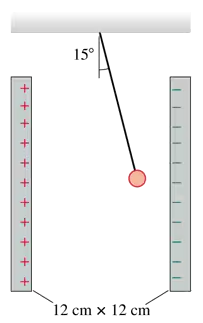
FIGURE EX23.25 shows a 1.51.5 g ball hanging from a string inside a parallel-plate capacitor made with 12 cm × 12 cm electrodes. The electrodes are charged to±75 nC. What is the charge on the ball in nC?
A 1.5 g ball hangs at a 15° angle from a string between charged parallel plates, measuring 12 cm by 12 cm.

Verified step by step guidance
1
Step 1: Begin by understanding the setup of the problem. The ball is hanging inside a parallel-plate capacitor, which creates a uniform electric field between the plates. The charge on the ball will interact with this electric field, causing a force. The goal is to determine the charge on the ball.
Step 2: Recall the relationship between the electric field (E) and the charge density on the plates. The electric field between parallel plates is given by the formula: E=σ/ε0, where σ is the surface charge density and ε0 is the permittivity of free space.
Step 3: Calculate the surface charge density σ using the formula: σ=Q/A, where Q is the total charge on the plates and A is the area of the plates. The area of the plates can be calculated as A=12×12 cm², converted to m².
Step 4: Once the electric field E is determined, use the force equation F=qE, where F is the force acting on the ball, q is the charge on the ball, and E is the electric field. The force can be related to the tension in the string and the weight of the ball.
Step 5: Analyze the forces acting on the ball. The ball is in equilibrium, so the vertical component of the tension balances the weight of the ball (mg), and the horizontal component of the tension is equal to the electric force (qE). Use trigonometry to resolve the components of the tension and solve for q, the charge on the ball.

Verified video answer for a similar problem:

This video solution was recommended by our tutors as helpful for the problem above.
Video duration:
12m
Was this helpful?

Key Concepts

Here are the essential concepts you must grasp in order to answer the question correctly.

Electric Field

An electric field is a region around a charged object where other charged objects experience a force. It is defined as the force per unit charge and is represented by the symbol E. In the context of a parallel-plate capacitor, the electric field is uniform between the plates and can be calculated using the voltage across the plates and the distance between them.
Recommended video:
Guided course
03:16
Intro to Electric Fields

Coulomb's Law

Coulomb's Law describes the force between two point charges. It states that the force is directly proportional to the product of the magnitudes of the charges and inversely proportional to the square of the distance between them. This law is fundamental in understanding how charged objects interact, including the ball in the electric field of the capacitor.
Recommended video:
Guided course
09:52
Coulomb's Law

Charge Conservation

Charge conservation is a fundamental principle stating that the total electric charge in an isolated system remains constant over time. In this scenario, the ball hanging in the capacitor will acquire a charge due to the electric field created by the charged plates, but the total charge in the system (including the ball and the capacitor) will remain unchanged.
Recommended video:
Guided course
05:43
Conservation of Charge
Related Practice
Textbook Question

A proton is fired horizontally into a 1.0×10⁵ N/C vertical electric field. It rises 1.0 cm vertically after having traveled 5.0 cm horizontally. What was the proton's initial speed?

2173
views
1
rank

Textbook Question

Air 'breaks down' when the electric field strength reaches 3.0×10⁶ N/C, causing a spark. A parallel-plate capacitor is made from two 4.0 cm×4.0 cm electrodes. How many electrons must be transferred from one electrode to the other to create a spark between the electrodes?

244
views
Textbook Question

Two 10-cm-diameter charged disks face each other, 20 cm apart. The left disk is charged to −50 nC and the right disk is charged to +50 nC. a. What is the electric field Ē, both magnitude and direction, at the midpoint between the two disks?

1491
views
Textbook Question

Two 2.0-cm-diameter disks face each other, 1.0 mm apart. They are charged to ±10 nC. A proton is shot from the negative disk toward the positive disk. What launch speed must the proton have to just barely reach the positive disk?

202
views
Textbook Question

You’ve hung two very large sheets of plastic facing each other with distance d between them, as shown in FIGURE EX23.19. By rubbing them with wool and silk, you’ve managed to give one sheet a uniform surface charge density η1=η0η_1=−η_0 and the other a uniform surface charge density η2=+3η0η_2=+3η_0. What are the electric field vectors at points 1, 2, and 3?

1431
views
Textbook Question

INT The surface charge density on an infinite charged plane is −2.0×10⁻⁶ C/m2. A proton is shot straight away from the plane at 2.0×10⁶ m/s. How far does the proton travel before reaching its turning point?

2301
views