
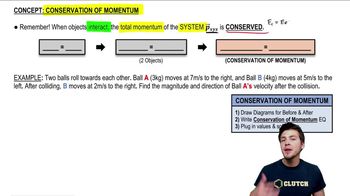
A 100 g ball moving to the right at 4.0 m/s collides head-on with a 200g ball that is moving to the left at 3.0 m/s. If the collision is perfectly elastic, what are the speed and direction of each ball after the collision?
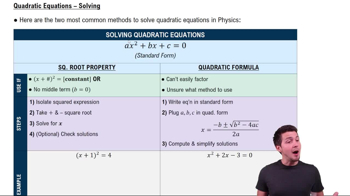
Consider a partially elastic collision in which ball A of mass m with initial velocity (vix)A collides with stationary ball B, also of mass m, and in which 1/4 of the mechanical energy is dissipated as thermal energy. Find expressions for the final velocities of each ball. Hint: Mathematically there are two solutions; however, one of them is physically impossible.
Verified step by step guidance
Verified video answer for a similar problem:
Key Concepts
Conservation of Momentum
Kinetic Energy and Elasticity
Physical Feasibility of Solutions
A 30 ton rail car and a 90 ton rail car, initially at rest, are connected together with a giant but massless compressed spring between them. When released, the 30 ton car is pushed away at a speed of 4.0 m/s relative to the 90 ton car. What is the speed of the 30 ton car relative to the ground?
A 45 g projectile explodes into three pieces: a 20 g piece with velocity 25 î m/s, a 15 g piece with velocity −10 î + 10ĵ m/s, and a 10 g piece with velocity −15 î − 20ĵ m/s. What was the projectile's velocity just before the explosion?
The nucleus of the polonium isotope ²¹⁴Po (mass 214 u) is radioactive and decays by emitting an alpha particle (a helium nucleus with mass 4 u). Laboratory experiments measure the speed of the alpha particle to be 1.92×10⁷ m/s . Assuming the polonium nucleus was initially at rest, what is the recoil speed of the nucleus that remains after the decay?
One end of a massless, 30-cm-long spring with spring constant 15 N/m is attached to a 250 g stationary air-track glider; the other end is attached to the track. A 500 g glider hits and sticks to the 250 g glider, compressing the spring to a minimum length of 22 cm. What was the speed of the 500 g glider just before impact?
A neutron is an electrically neutral subatomic particle with a mass just slightly greater than that of a proton. A free neutron is radioactive and decays after a few minutes into other subatomic particles. In one experiment, a neutron at rest was observed to decay into a proton (mass 1.67×10⁻²⁷ kg) and an electron (mass 9.11×10⁻³¹ kg) . The proton and electron were shot out back-to-back. The proton speed was measured to be 1.0 ×10⁵ m/s, and the electron speed was 3.0×10⁷ m/s. No other decay products were detected. How much momentum did this neutrino 'carry away' with it?
