
Two loudspeakers emit sound waves along the x-axis. The sound has maximum intensity when the speakers are 20 cm apart. The sound intensity decreases as the distance between the speakers is increased, reaching zero at a separation of 60 cm. What is the wavelength of the sound?
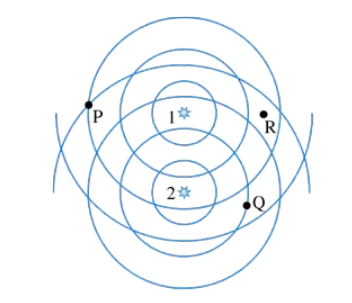
FIGURE EX17.27 shows the circular wave fronts emitted by two wave sources. Make a table with rows labeled P, Q, and R and columns labeled r1, r2, Δr, and C/D. Fill in the table for points P, Q, and R, giving the distances as multiples of λ and indicating, with a C or a D, whether the interference at that point is constructive or destructive.

Verified step by step guidance
Verified video answer for a similar problem:
Key Concepts
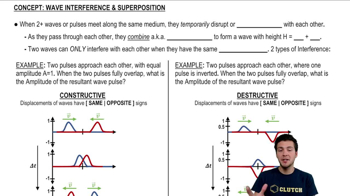
Wave Interference
Path Difference (Δr)
Wavelength (λ)
Two strings are adjusted to vibrate at exactly 200 Hz. Then the tension in one string is increased slightly. Afterward, three beats per second are heard when the strings vibrate at the same time. What is the new frequency of the string that was tightened?
What is the thinnest film of MgF2 (n=1.39) on glass that produces a strong reflection for orange light with a wavelength of 600 nm?
A flute player hears four beats per second when she compares her note to a 523 Hz tuning fork (the note C). She can match the frequency of the tuning fork by pulling out the 'tuning joint' to lengthen her flute slightly. What was her initial frequency?
Two loudspeakers in a 20°C room emit 686 Hz sound waves along the x-axis. If the speakers are out of phase, what is the smallest distance between the speakers for which the interference of the sound waves is maximum constructive?
Two out-of-phase radio antennas at x=±300 m on the x-axis are emitting 3.0 MHz radio waves. Is the point (x, y) =(300 m, 800 m) a point of maximum constructive interference, maximum destructive interference, or something in between?
