Ch 10: Interactions and Potential Energy
Knight Calc - Physics for Scientists and Engineers 5th Edition
Knight Calc5th EditionPhysics for Scientists and EngineersISBN: 9780137344796Not the one you use?Change textbook
Chapter 10, Problem 12

The maximum energy a bone can absorb without breaking is surprisingly small. Experimental data show that a leg bone of a healthy, 60 kg human can absorb about 200 J. From what maximum height could a 60 kg person jump and land rigidly upright on both feet without breaking his legs? Assume that all energy is absorbed by the leg bones in a rigid landing.

Verified step by step guidance
1
Step 1: Identify the given values in the problem. The mass of the person is 60 kg, and the maximum energy the leg bones can absorb is 200 J. The goal is to find the maximum height from which the person can jump without breaking their legs.
Step 2: Recall the formula for gravitational potential energy, which is given by: E=mgh, where E is the energy, m is the mass, g is the acceleration due to gravity (approximately 9.8 m/s²), and h is the height.
Step 3: Rearrange the formula to solve for height h. The equation becomes: h=Emg.
Step 4: Substitute the known values into the formula. Use E=200, m=60, and g=9.8. The equation becomes: h=20060×9.8.
Step 5: Perform the division and multiplication to calculate the height. This will give the maximum height from which the person can jump without breaking their legs. Ensure units are consistent throughout the calculation.

Verified video answer for a similar problem:

This video solution was recommended by our tutors as helpful for the problem above.
Video duration:
3m
Was this helpful?

Key Concepts

Here are the essential concepts you must grasp in order to answer the question correctly.

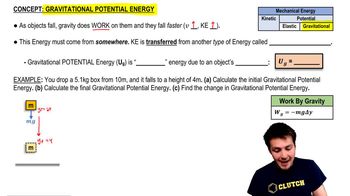
Gravitational Potential Energy

Gravitational potential energy (GPE) is the energy an object possesses due to its position in a gravitational field. It is calculated using the formula GPE = mgh, where m is mass, g is the acceleration due to gravity (approximately 9.81 m/s² on Earth), and h is the height above the ground. In this context, it helps determine how high a person can jump before the energy from the fall exceeds the bone's energy absorption limit.
Recommended video:
Guided course
06:35
Gravitational Potential Energy

Energy Conservation

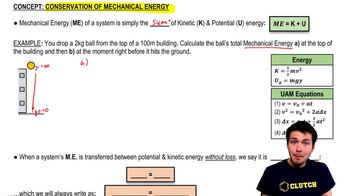
The principle of energy conservation states that energy cannot be created or destroyed, only transformed from one form to another. In this scenario, the kinetic energy of the person just before landing is converted into gravitational potential energy during the jump. Understanding this principle is crucial for calculating the maximum height a person can jump without exceeding the energy absorption capacity of their bones.
Recommended video:
Guided course
06:24
Conservation Of Mechanical Energy

Rigid Landing

A rigid landing refers to landing in a way that does not allow for any bending or flexing of the legs, which would otherwise help absorb some of the impact energy. In this case, the entire energy from the fall is transferred to the leg bones. This concept is important because it simplifies the analysis by assuming that all the energy from the jump is absorbed by the bones, leading to a direct calculation of the maximum height based on the energy absorption limit.
Recommended video:
Guided course
08:02
An Unfortunate Landing
Related Practice
Textbook Question

A pendulum is made by tying a 500 g ball to a 75-cm-long string. The pendulum is pulled 30° to one side, then released. What is the ball's speed at the lowest point of its trajectory?

2052
views

Textbook Question
The spring in FIGURE EX10.21a is compressed by 10 cm. It launches a block across a frictionless surface at 0.50 m/s. The two springs in Figure EX10.21b are identical to the spring of Figure EX10.21a. They are compressed by the same 10 cm and launch the same block. What is the block's speed now?
1655
views
Textbook Question

A 1500 kg car traveling at 10 m/s suddenly runs out of gas while approaching the valley shown in FIGURE EX10.11. The alert driver immediately puts the car in neutral so that it will roll. What will be the car's speed as it coasts into the gas station on the other side of the valley? Ignore rolling friction.

2777
views
1
rank
Textbook Question

In a hydroelectric dam, water falls 25 m and then spins a turbine to generate electricity. Suppose the dam is 80% efficient at converting the water's potential energy to electrical energy. How many kilograms of water must pass through the turbines each second to generate 50 MW of electricity? This is a typical value for a small hydroelectric dam.

2331
views
Textbook Question

In a hydroelectric dam, water falls 25 m and then spins a turbine to generate electricity. What is ΔUG\(\Delta\) U_{G} of 1.0 kg of water?

2224
views
Textbook Question

A stretched spring stores 2.0 J of energy. How much energy will be stored if the spring is stretched three times as far?

1446
views