Ch 04: Kinematics in Two Dimensions
Knight Calc - Physics for Scientists and Engineers 5th Edition
Knight Calc5th EditionPhysics for Scientists and EngineersISBN: 9780137344796Not the one you use?Change textbook
Chapter 4, Problem 47

A projectile's horizontal range over level ground is v02sin2θg\(\frac{v_0^2 \sin 2\theta}{g}\). At what launch angle or angles will the projectile land at half of its maximum possible range?

Verified step by step guidance
1
Start by recalling the formula for the horizontal range of a projectile: R = \(\frac{v_0^2 \sin(2\theta)}{g}\), where v_0 is the initial velocity, \(\theta\) is the launch angle, and g is the acceleration due to gravity.
The maximum possible range occurs when \(\sin\)(2\(\theta\)) = 1, which happens at 2\(\theta\) = 90^\(\circ\) or \(\theta\) = 45^\(\circ\). Substituting this into the range formula gives the maximum range as R_{\(\text{max}\)} = \(\frac{v_0^2}{g}\).
To find the angle(s) at which the projectile lands at half the maximum range, set the range equal to half of R_{\(\text{max}\)}: \(\frac{v_0^2 \sin(2\theta)}{g}\) = \(\frac{1}{2}\) \(\cdot\) \(\frac{v_0^2}{g}\).
Simplify the equation by canceling \(\frac{v_0^2}{g}\) on both sides: \(\sin\)(2\(\theta\)) = \(\frac{1}{2}\).
Solve for 2\(\theta\) using the inverse sine function: 2\(\theta\) = \(\arcsin\)(\(\frac{1}{2}\)). This gives two possible solutions for 2\(\theta\) within one full rotation: 2\(\theta\) = 30^\(\circ\) and 2\(\theta\) = 150^\(\circ\). Divide each by 2 to find the corresponding launch angles: \(\theta\) = 15^\(\circ\) and \(\theta\) = 75^\(\circ\).

Verified video answer for a similar problem:

This video solution was recommended by our tutors as helpful for the problem above.
Video duration:
7m
Was this helpful?

Key Concepts

Here are the essential concepts you must grasp in order to answer the question correctly.

Projectile Motion

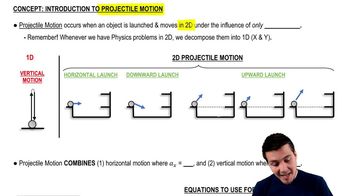
Projectile motion refers to the motion of an object that is launched into the air and is subject to the force of gravity. It can be analyzed in two dimensions: horizontal and vertical. The horizontal motion is uniform, while the vertical motion is influenced by gravitational acceleration. Understanding the principles of projectile motion is essential for determining the range and trajectory of the projectile.
Recommended video:
Guided course
04:44
Introduction to Projectile Motion

Range of a Projectile

The range of a projectile is the horizontal distance it travels before landing, which is influenced by its initial velocity, launch angle, and the acceleration due to gravity. The formula for the maximum range is given by R = v₀² sin 2θ/g, where v₀ is the initial velocity, θ is the launch angle, and g is the acceleration due to gravity. This relationship shows how the angle of launch affects the distance traveled.
Recommended video:
Guided course
04:44
Introduction to Projectile Motion

Launch Angle

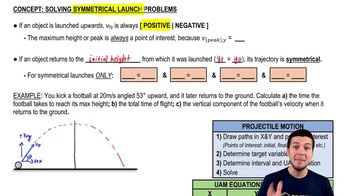
The launch angle is the angle at which a projectile is launched relative to the horizontal. It plays a critical role in determining the range and height of the projectile's trajectory. For maximum range, the optimal launch angle is 45 degrees. To find the angles that yield half of the maximum range, one must analyze the sine function in the range formula, which can yield multiple angles for a given range.
Recommended video:
Guided course
12:39
Solving Symmetric Launch Problems
Related Practice
Textbook Question

Starting from rest, a DVD steadily accelerates to 500 rpm in 1.0 s, rotates at this angular speed for 3.0 s, then steadily decelerates to a halt in 2.0 s. How many revolutions does it make?

2078
views

Textbook Question

A projectile is launched from ground level at angle θ and speed v0 into a headwind that causes a constant horizontal acceleration of magnitude a opposite the direction of motion. Find an expression in terms of a and g for the launch angle that gives maximum range.

2230
views
Textbook Question

A gray kangaroo can bound across level ground with each jump carrying it 10 m from the takeoff point. Typically the kangaroo leaves the ground at a 20° angle. If this is so: What is its maximum height above the ground?

451
views
Textbook Question

A spaceship maneuvering near Planet Zeta is located at r=(600i400j+200k)×103km,\(\mathbf{r}\) = (600\(\mathbf{i}\) - 400\(\mathbf{j}\) + 200\(\mathbf{k}\)) \(\times\) 10^3 \, \(\text{km}\), relative to the planet, and traveling at v=9500im/s\(\mathbf{v}\) = 9500\(\mathbf{i}\) \, \(\text{m/s}\). It turns on its thruster engine and accelerates with a=(40i20k)m/s2\(\mathbf{a}\) = (40\(\mathbf{i}\) - 20\(\mathbf{k}\)) \, \(\text{m/s}\)^2 for 35 min35\(\text{ min}\). What is the spaceship's position when the engine shuts off? Give your answer as a position vector measured in km\(\operatorname{km}\).

2136
views
Textbook Question

A 5.0-m-diameter merry-go-round is initially turning with a 4.0 s period. It slows down and stops in 20 s. How many revolutions does the merry-go-round make as it stops?

2227
views
Textbook Question

A projectile is launched from ground level at angle θ and speed v₀ into a headwind that causes a constant horizontal acceleration of magnitude a opposite the direction of motion. What is the angle for maximum range if a is 10% of g?

2490
views
1
rank