Ch 23: The Electric Field
Knight Calc - Physics for Scientists and Engineers 5th Edition
Knight Calc5th EditionPhysics for Scientists and EngineersISBN: 9780137344796Not the one you use?Change textbook
Chapter 23, Problem 31b

Electrostatic cleaners remove small dust particles and pollen grains from air by first ionizing them, then flowing the air between the plates of a parallel-plate capacitor, parallel to the plates, where electric forces deposit charged particles on one of the electrodes. A typical pollen grain has a mass of 5.0×10105.0\(\times\)10^{-10} g, the ionizer charges it with 750750 extra electrons, and a fan moves the air at 3.03.0 m/s. Ignore air resistance and gravity. What minimum electric field strength is needed to deflect the grain by 3.03.0 mm before it leaves the electrodes?

Verified step by step guidance
1
Step 1: Convert the mass of the pollen grain from grams to kilograms. Since 1 gram = 10^−3 kilograms, multiply the given mass (5.0×10^−10 g) by 10^−3 to express it in kilograms.
Step 2: Calculate the charge on the pollen grain. The charge is determined by the number of extra electrons multiplied by the elementary charge (e = 1.6×10^−19 C). Use the formula: q = (number of electrons) × e.
Step 3: Determine the time the pollen grain spends between the plates. The time can be calculated using the formula: t = d / v, where d is the length of the plates (not given explicitly, but implied by the problem setup) and v is the velocity of the air (3.0 m/s).
Step 4: Relate the deflection distance (3.0 mm, converted to meters) to the acceleration caused by the electric field. Use the kinematic equation: y = (1/2) a t^2, where y is the deflection distance, a is the acceleration, and t is the time calculated in Step 3.
Step 5: Calculate the minimum electric field strength required to produce the acceleration. Use Newton's second law: F = ma, where F is the force exerted by the electric field (F = qE), m is the mass of the pollen grain, and a is the acceleration derived in Step 4. Solve for E using the formula: E = F / q.

Verified video answer for a similar problem:

This video solution was recommended by our tutors as helpful for the problem above.
Video duration:
14m
Was this helpful?

Key Concepts

Here are the essential concepts you must grasp in order to answer the question correctly.

Electric Field

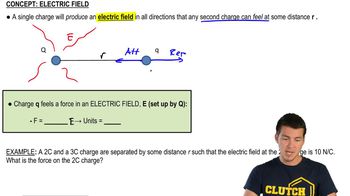
An electric field is a region around a charged particle where other charged particles experience a force. It is defined as the force per unit charge and is measured in volts per meter (V/m). In this context, the electric field is crucial for determining how charged particles, like pollen grains, will be influenced by the forces acting on them as they move through the capacitor.
Recommended video:
Guided course
03:16
Intro to Electric Fields

Force on a Charged Particle

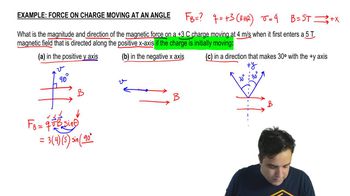
The force acting on a charged particle in an electric field can be calculated using Coulomb's law, which states that the force (F) is equal to the charge (q) multiplied by the electric field strength (E). This relationship is essential for understanding how the pollen grain, once ionized and charged, will experience a force that can deflect it within the electric field created by the capacitor plates.
Recommended video:
Guided course
06:21
Force on Charge Moving at an Angle

Kinematics of Motion

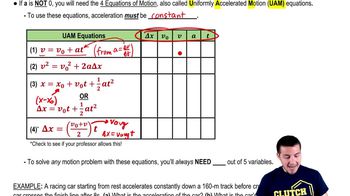
Kinematics is the branch of mechanics that deals with the motion of objects without considering the forces that cause the motion. In this scenario, understanding the kinematic equations is important to calculate the time it takes for the pollen grain to travel a certain distance and how far it will deflect under the influence of the electric field before exiting the capacitor.
Recommended video:
Guided course
08:25
Kinematics Equations
Related Practice
Textbook Question

A proton is fired horizontally into a 1.0×10⁵ N/C vertical electric field. It rises 1.0 cm vertically after having traveled 5.0 cm horizontally. What was the proton's initial speed?

2173
views
1
rank

Textbook Question

What are the strength and direction of the electric field at the position indicated by the dot in FIGURE P23.37? Give your answer (a) in component form and (b) as a magnitude and angle measured cw or ccw (specify which) from the positive x-axis.

210
views
Textbook Question

Two 2.0-cm-diameter disks face each other, 1.0 mm apart. They are charged to ±10 nC. A proton is shot from the negative disk toward the positive disk. What launch speed must the proton have to just barely reach the positive disk?

202
views
Textbook Question

A −15 nC charge is at x=+2.0 cm on the x-axis. A second charge q is located somewhere on the x-axis to the left of the origin. The electric field at y=2.0 cm on the y-axis is E=3.0×10⁵i^\(\overrightarrow{E}\)=3.0\(\times\)10^5\(\hat{i}\)N/C . What are (a) the charge q in nC and (b) its distance from the origin?

2589
views
Textbook Question

INT The surface charge density on an infinite charged plane is −2.0×10⁻⁶ C/m2. A proton is shot straight away from the plane at 2.0×10⁶ m/s. How far does the proton travel before reaching its turning point?

2301
views
Textbook Question

The permanent electric dipole moment of the water molecule (H2O) is 6.2×10306.2\(\times\)10^{-30} Cm. What is the maximum possible torque on a water molecule in a 5.0×1085.0×10^8 N/C electric field?

2671
views