A glass rod that has been charged to +12 nC touches a metal sphere. Afterward, the rod’s charge is +8.0 nC. How many charged particles were transferred?
Ch 22: Electric Charges and Forces
Knight Calc5th EditionPhysics for Scientists and EngineersISBN: 9780137344796Not the one you use?Change textbook
Chapter 22, Problem 7
A linear accelerator uses alternating electric fields to accelerate electrons to close to the speed of light. A small number of the electrons collide with a target, but a large majority pass through the target and impact a beam dump at the end of the accelerator. In one experiment the beam dump measured charge accumulating at a rate of −2.0 nC/s. How many electrons traveled down the accelerator during the 2.0 h run?
Verified step by step guidance1
Step 1: Understand the relationship between charge and the number of electrons. The charge of a single electron is approximately −1.6 × 10⁻¹⁹ C. This means that the total charge accumulated can be used to calculate the number of electrons by dividing the total charge by the charge of a single electron.
Step 2: Calculate the total charge accumulated during the 2.0-hour run. Since the charge accumulates at a rate of −2.0 nC/s, multiply this rate by the total time in seconds. Convert 2.0 hours into seconds by multiplying by 3600 seconds/hour.
Step 3: Perform the multiplication to find the total charge accumulated over the 2.0-hour period. Use the formula: \( Q = \text{rate} imes \text{time} \), where \( Q \) is the total charge, \( \text{rate} \) is −2.0 nC/s, and \( \text{time} \) is the total time in seconds.
Step 4: Convert the total charge from nanocoulombs (nC) to coulombs (C). Recall that 1 nC = 10⁻⁹ C. This step ensures the units are consistent for further calculations.
Step 5: Divide the total charge (in coulombs) by the charge of a single electron (−1.6 × 10⁻¹⁹ C) to find the total number of electrons that traveled down the accelerator during the experiment. Use the formula: \( N = \frac{Q}{e} \), where \( N \) is the number of electrons, \( Q \) is the total charge, and \( e \) is the charge of a single electron.

Verified video answer for a similar problem:
This video solution was recommended by our tutors as helpful for the problem above.
Video duration:
4mWas this helpful?
Key Concepts
Here are the essential concepts you must grasp in order to answer the question correctly.
Charge and Electrons
Charge is a fundamental property of matter that causes it to experience a force in an electric field. Electrons carry a negative charge of approximately -1.6 x 10^-19 coulombs. Understanding the relationship between charge and the number of electrons is crucial for calculating how many electrons contribute to a given charge accumulation.
Recommended video:
Guided course
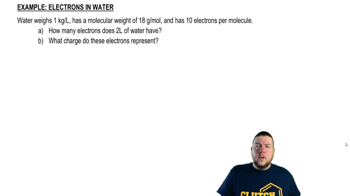
Electrons In Water (Using Density)
Current and Charge Flow
Electric current is the flow of electric charge, measured in amperes (A), where 1 A equals 1 coulomb per second. The rate of charge accumulation can be related to current, allowing us to determine how much charge has flowed over a specific time period. This relationship is essential for converting the charge rate into the total number of electrons.
Recommended video:
Guided course
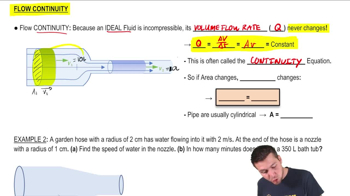
Flow Continuity
Time Conversion
Time conversion is necessary when calculating total charge over a period. In this case, the experiment runs for 2.0 hours, which must be converted into seconds for consistency with the charge rate given in nC/s. Understanding how to convert hours into seconds is vital for accurate calculations in physics problems involving time-dependent quantities.
Recommended video:
Guided course
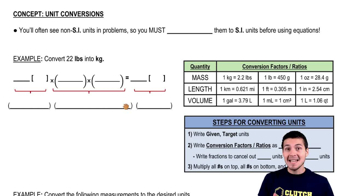
Unit Conversions
Related Practice
Textbook Question
1766
views
Textbook Question
Two protons are 2.0 fm apart. What is the magnitude of the gravitational force on one proton due to the other proton?
44
views
Textbook Question
Figure 22.8 showed how an electroscope becomes negatively charged. The leaves will also repel each other if you touch the electroscope with a positively charged glass rod. Use a series of charge diagrams to explain what happens and why the leaves repel each other.
2266
views
Textbook Question
What is the total charge of all the electrons in L of liquid water?
1898
views
Textbook Question
What mass of aluminum has a total nuclear charge of C? Aluminum has atomic number .
2424
views
2
comments
Textbook Question
Two small plastic spheres each have a mass of 2.0 g and a charge of −50.0 nC. They are placed 2.0 cm apart (center to center). What is the magnitude of the electric force on each sphere?
1694
views
1
rank