Ch 34: Ray Optics
Knight Calc - Physics for Scientists and Engineers 5th Edition
Knight Calc5th EditionPhysics for Scientists and EngineersISBN: 9780137344796Not the one you use?Change textbook
Chapter 34, Problem 54a

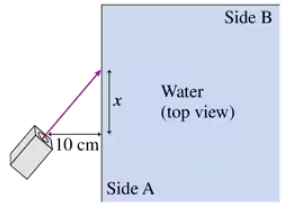
Shown from above in FIGURE P34.54 is one corner of a rectangular box filled with water. A laser beam starts 10 cm from side A of the container and enters the water at position x. You can ignore the thin walls of the container. If x = 15 cm, does the laser beam refract back into the air through side B or reflect from side B back into the water? Determine the angle of refraction or reflection.

Verified step by step guidance
1
Identify the key concepts involved in the problem: refraction and total internal reflection. Refraction occurs when light passes from one medium to another, changing its speed and direction. Total internal reflection occurs when light traveling in a denser medium (water) hits the boundary with a less dense medium (air) at an angle greater than the critical angle, causing it to reflect back into the denser medium.
Determine the geometry of the problem. The laser beam enters the water at position x = 15 cm. The distance from side A to the entry point is 10 cm. Use this information to calculate the angle of incidence at side B. The angle of incidence can be found using trigonometry: \( \tan(\theta_i) = \frac{\text{opposite side}}{\text{adjacent side}} \), where the opposite side is the distance from the entry point to side B, and the adjacent side is the depth of the water.
Apply Snell's Law to determine whether the light refracts or reflects. Snell's Law is given by \( n_1 \sin(\theta_i) = n_2 \sin(\theta_r) \), where \( n_1 \) and \( n_2 \) are the refractive indices of water and air, respectively, \( \theta_i \) is the angle of incidence, and \( \theta_r \) is the angle of refraction. Use the refractive index of water (approximately 1.33) and air (approximately 1.00).
Calculate the critical angle for total internal reflection. The critical angle \( \theta_c \) is given by \( \sin(\theta_c) = \frac{n_2}{n_1} \). If the angle of incidence \( \theta_i \) is greater than \( \theta_c \), total internal reflection occurs, and the light reflects back into the water. Otherwise, the light refracts into the air.
Compare the calculated angle of incidence \( \theta_i \) with the critical angle \( \theta_c \). If \( \theta_i > \theta_c \), the laser beam reflects back into the water. If \( \theta_i \leq \theta_c \), the laser beam refracts into the air. Use the calculated values to determine the angle of refraction or reflection as required.

Verified video answer for a similar problem:

This video solution was recommended by our tutors as helpful for the problem above.
Video duration:
7m
Was this helpful?

Key Concepts

Here are the essential concepts you must grasp in order to answer the question correctly.

Refraction

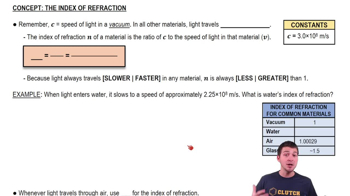
Refraction is the bending of light as it passes from one medium to another, caused by a change in its speed. When light travels from air (less dense) into water (more dense), it slows down and bends towards the normal line. The degree of bending can be calculated using Snell's Law, which relates the angles of incidence and refraction to the indices of refraction of the two media.
Recommended video:
Guided course
03:46
Index of Refraction

Snell's Law

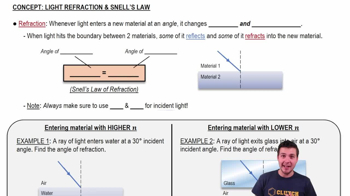
Snell's Law describes the relationship between the angles of incidence and refraction when light passes between two different media. It is mathematically expressed as n1 * sin(θ1) = n2 * sin(θ2), where n1 and n2 are the indices of refraction for the two media, and θ1 and θ2 are the angles of incidence and refraction, respectively. This law is essential for determining how much the light will bend when entering the water from air.
Recommended video:

Total Internal Reflection

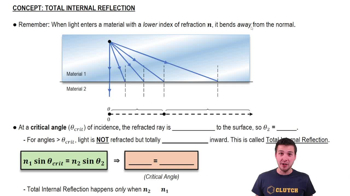
Total internal reflection occurs when a light ray attempts to move from a denser medium to a less dense medium at an angle greater than the critical angle, resulting in the light being completely reflected back into the denser medium. The critical angle can be calculated using the indices of refraction of the two media. Understanding this concept is crucial for determining whether the laser beam will reflect off side B or refract into the air.
Recommended video:
Guided course
05:29
Total Internal Reflection
Related Practice
Textbook Question

A 4.0-m-wide swimming pool is filled to the top. The bottom of the pool becomes completely shaded in the afternoon when the sun is 20° above the horizon. How deep is the pool?

1622
views

Textbook Question

Shown from above in FIGURE P34.54 is one corner of a rectangular box filled with water. A laser beam starts 10 cm from side A of the container and enters the water at position x. You can ignore the thin walls of the container. Find the minimum value of x for which the laser beam passes through side B and emerges into the air.

130
views
Textbook Question

Optical engineers need to know the cone of acceptance of an optical fiber. This is the maximum angle that an entering light ray can make with the axis of the fiber if it is to be guided down the fiber. What is the cone of acceptance of an optical fiber for which the index of refraction of the core is 1.55 while that of the cladding is 1.45? You can model the fiber as a cylinder with a flat entrance face.

155
views
Textbook Question

A horizontal laser beam enters the glass prism shown in FIGURE P34.55. When the laser beam exits the prism, by what angle will it have been deflected from horizontal?

2374
views
Textbook Question

A horizontal meter stick is centered at the bottom of a 3.0-m-deep, 3.0-m-wide pool of water. Suppose you place your eye just above the edge of the pool and look along the direction of the meter stick. What angle do you observe between the two ends of the meter stick if the pool is (a) empty and (b) completely filled with water?

71
views
Textbook Question

An astronaut is exploring an unknown planet when she accidentally drops an oxygen canister into a 1.50-m-deep pool filled with an unknown liquid. Although she dropped the canister 21 cm from the edge, it appears to be 31 cm away when she peers in from the edge. What is the liquid's index of refraction? Assume that the planet's atmosphere is similar to earth's.

67
views