
Ch 33: Wave Optics
Knight Calc - Physics for Scientists and Engineers 5th Edition
Knight Calc5th EditionPhysics for Scientists and EngineersISBN: 9780137344796Not the one you use?Change textbook
Chapter 33, Problem 51b

Use your expression from part a to find an expression for the separation Δy on the screen of two fringes that differ in wavelength by Δλ.

Verified step by step guidance
1
Step 1: Recall the formula for fringe separation in a double-slit interference pattern: Δy = (λL) / d, where λ is the wavelength, L is the distance from the slits to the screen, and d is the slit separation.
Step 2: To find the separation Δy for two fringes differing in wavelength by Δλ, consider the change in fringe position due to the change in wavelength. The fringe separation for wavelength λ + Δλ can be expressed as Δy' = ((λ + Δλ)L) / d.
Step 3: Subtract the fringe separation for wavelength λ from the fringe separation for wavelength λ + Δλ to find the difference in fringe positions: Δy_difference = Δy' - Δy = (((λ + Δλ)L) / d) - ((λL) / d).
Step 4: Simplify the expression for Δy_difference by factoring out common terms: Δy_difference = (L / d) * Δλ.
Step 5: Conclude that the separation Δy between two fringes differing in wavelength by Δλ is directly proportional to Δλ, with the proportionality constant being (L / d).

Verified video answer for a similar problem:

This video solution was recommended by our tutors as helpful for the problem above.
Video duration:
4m
Was this helpful?

Key Concepts

Here are the essential concepts you must grasp in order to answer the question correctly.

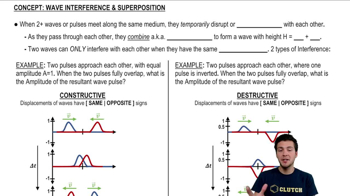
Interference Patterns

Interference patterns are created when two or more coherent light waves overlap, resulting in regions of constructive and destructive interference. In a double-slit experiment, for example, bright fringes occur where waves reinforce each other, while dark fringes occur where they cancel out. Understanding these patterns is crucial for analyzing how different wavelengths affect fringe separation.
Recommended video:
Guided course
03:47
Wave Interference & Superposition

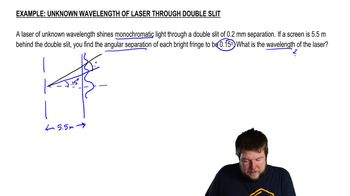
Wavelength and Fringe Separation

The wavelength of light is a key factor in determining the spacing of interference fringes on a screen. The separation between fringes, denoted as Δy, is directly proportional to the wavelength (λ) and inversely proportional to the distance between the slits and the screen. This relationship allows us to derive expressions that relate changes in wavelength to changes in fringe separation.
Recommended video:
Guided course
05:42
Unknown Wavelength of Laser through Double Slit

Differential Wavelength Effect

When considering two wavelengths that differ by Δλ, the resulting fringe separation on the screen will also differ. The change in fringe position can be expressed mathematically, allowing us to calculate the separation Δy between fringes corresponding to these two wavelengths. This concept is essential for understanding how variations in wavelength influence the observed interference pattern.
Recommended video:
Guided course
07:40
The Doppler Effect
Related Practice
Textbook Question

A helium-neon laser (λ = 633 nm) is built with a glass tube of inside diameter 1.0 mm, as shown in FIGURE P33.62. One mirror is partially transmitting to allow the laser beam out. An electrical discharge in the tube causes it to glow like a neon light. From an optical perspective, the laser beam is a light wave that diffracts out through a 1.0-mm-diameter circular opening. Can a laser beam be perfectly parallel, with no spreading? Why or why not?

102
views
Textbook Question

White light (400–700 nm) incident on a 600 lines/mm diffraction grating produces rainbows of diffracted light. What is the width of the first-order rainbow on a screen 2.0 m behind the grating?

89
views
Textbook Question

A helium-neon laser (λ = 633 nm) is built with a glass tube of inside diameter 1.0 mm, as shown in FIGURE P33.62. One mirror is partially transmitting to allow the laser beam out. An electrical discharge in the tube causes it to glow like a neon light. From an optical perspective, the laser beam is a light wave that diffracts out through a 1.0-mm-diameter circular opening. What is the diameter (in mm) of the laser beam after it travels 3.0 m? Note that the wave model is appropriate because the spreading, at this distance, is significantly larger than the size of the opening.

74
views
Textbook Question

Two vertical, high-frequency radio antennas are 20 m apart. 2.0 km away, in a plane parallel to the plane of the antennas, 'bright' spots of radio intensity are spaced 5.0 m apart, separated by spots with almost no radio intensity. What is the radio frequency?

119
views
Textbook Question

A diffraction grating has slit spacing d. Fringes are viewed on a screen at distance L. Find an expression for the wavelength of light that produces a first-order fringe on the viewing screen at distance L from the center of the screen.

87
views
Textbook Question

Helium atoms emit light at several wavelengths. Light from a helium lamp illuminates a diffraction grating and is observed on a screen 50.00 cm behind the grating. The emission at wavelength 501.5 nm creates a first-order bright fringe 21.90 cm from the central maximum. What is the wavelength of the bright fringe that is 31.60 cm from the central maximum?

96
views