
Textbook Question
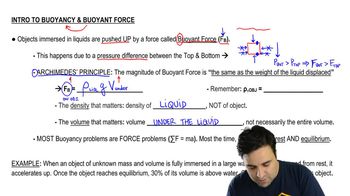
An aquarium of length L, width (front to back) W, and depth D is filled to the top with liquid of density ρ. Find an expression for the force of the liquid on the front window of the aquarium.
2275
views

 Verified step by step guidance
 11:06
11:06
 8:13
8:13 05:21
05:21An aquarium of length L, width (front to back) W, and depth D is filled to the top with liquid of density ρ. Find an expression for the force of the liquid on the front window of the aquarium.
A pressure gauge reads 50 kPa as water flows at 10.0 m/s through a 16.8-cm-diameter horizontal pipe. What is the reading of a pressure gauge after the pipe has expanded to 20.0 cm in diameter?
It's possible to use the ideal-gas law to show that the density of the earth's atmosphere decreases exponentially with height. That is, ρ = ρ₀ exp (-z/z₀), where z is the height above sea level, ρ₀ is the density at sea level (you can use the Table 14.1 value), and z₀ is called the scale height of the atmosphere. What is the density of the air in Denver, at an elevation of 1600 m? What percent of sea-level density is this?
A nonviscous liquid of density p flows at speed v₀ through a horizontal pipe that expands smoothly from diameter d₀ to a larger diameter d₁. The pressure in the narrower section is p₀. Find an expression for the pressure p₁ in the wider section.
A nuclear power plant draws 3.0 x 10⁶ L/min of cooling water from the ocean. If the water is drawn in through two parallel, 3.0-m-diameter pipes, what is the water speed in each pipe?
The average density of the body of a fish is 1080 kg/m³ . To keep from sinking, a fish increases its volume by inflating an internal air bladder, known as a swim bladder, with air. By what percent must the fish increase its volume to be neutrally buoyant in fresh water? The density of air at 20°C is 119 kg/m³.