Ch 16: Traveling Waves
Knight Calc - Physics for Scientists and Engineers 5th Edition
Knight Calc5th EditionPhysics for Scientists and EngineersISBN: 9780137344796Not the one you use?Change textbook
Chapter 16, Problem 47

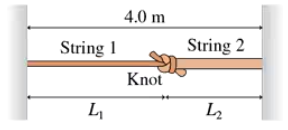
String 1 in FIGURE P16.47 has linear density 2.0 g/m and string 2 has linear density. A student sends pulses in both directions by quickly pulling up on the knot, then releasing it. What should the string lengths L₁ and L₂ be if the pulses are to reach the ends of the strings simultaneously?

Verified step by step guidance
1
Step 1: Understand the problem. The goal is to determine the lengths of the two strings, L₁ (green string) and L₂ (red string), such that pulses sent simultaneously from the knot reach the ends of the strings at the same time. This requires the pulse travel times to be equal for both strings.
Step 2: Recall the formula for wave speed on a string: v = √(T/μ), where v is the wave speed, T is the tension in the string, and μ is the linear density of the string. The linear density for string 1 is given as 2.0 g/m, and the linear density for string 2 is unspecified but can be denoted as μ₂.
Step 3: Write the relationship for travel time. The travel time for a pulse is t = L/v, where L is the length of the string and v is the wave speed. For the pulses to reach the ends simultaneously, the travel times for both strings must be equal: t₁ = t₂. Substituting the formula for wave speed, this becomes L₁/√(T/μ₁) = L₂/√(T/μ₂).
Step 4: Simplify the equation. Since the tension T is the same for both strings, it cancels out, leaving L₁/√μ₁ = L₂/√μ₂. Rearrange this equation to find the relationship between L₁ and L₂: L₁ = L₂ × √(μ₁/μ₂).
Step 5: Use the total length constraint. The total length of the two strings is given as L₁ + L₂ = 3.5 m. Combine this with the relationship from Step 4 to solve for L₁ and L₂. Substitute μ₁ = 2.0 g/m and μ₂ (linear density of string 2) into the equations to find the lengths.

Verified video answer for a similar problem:

This video solution was recommended by our tutors as helpful for the problem above.
Video duration:
5m
Was this helpful?

Key Concepts

Here are the essential concepts you must grasp in order to answer the question correctly.

Wave Speed in Strings

The speed of a wave traveling through a string is determined by the tension in the string and its linear density. The formula for wave speed (v) is given by v = √(T/μ), where T is the tension and μ is the linear density. This relationship is crucial for understanding how different strings will transmit wave pulses at different speeds based on their material properties.
Recommended video:
Guided course
04:39
Energy & Power of Waves on Strings

Linear Density

Linear density (μ) is defined as the mass per unit length of a string, typically expressed in grams per meter (g/m). It affects the wave speed; a higher linear density results in a slower wave speed for a given tension. In this problem, the linear densities of the two strings are essential for calculating the lengths required for the pulses to reach the ends simultaneously.
Recommended video:
Guided course
8:13
Intro to Density

Simultaneous Wave Propagation

For two wave pulses to reach the ends of their respective strings simultaneously, the time taken for each pulse to travel its length must be equal. This can be expressed mathematically as L₁/v₁ = L₂/v₂, where L is the length of the string and v is the wave speed. By manipulating this equation, one can determine the necessary lengths of the strings based on their linear densities.
Recommended video:
Guided course
07:32
Transverse Velocity of Waves
Related Practice
Textbook Question

A friend of yours is loudly singing a single note at 400 Hz while racing toward you at 25.0 m/s on a day when the speed of sound is 340 m/s. What frequency do you hear?

830
views

Textbook Question

One cue your hearing system uses to localize a sound (i.e., to tell where a sound is coming from) is the slight difference in the arrival times of the sound at your ears. Your ears are spaced approximately 20 cm apart. Consider a sound source 5.0 m from the center of your head along a line 45° to your right. What is the difference in arrival times? Give your answer in microseconds. Hint: You are looking for the difference between two numbers that are nearly the same. What does this near equality imply about the necessary precision during intermediate stages of the calculation?

1398
views
Textbook Question

FIGURE P16.45 is a snapshot graph at t = 0 s of a 5.0 Hz wave traveling to the left. Write the displacement equation for this wave.

2311
views
Textbook Question

A bat locates insects by emitting ultrasonic 'chirps' and then listening for echoes from the bugs. Suppose a bat chirp has a frequency of 25 kHz. How fast would the bat have to fly, and in what direction, for you to just barely be able to hear the chirp at 20 kHz?

1721
views
Textbook Question

Earthquakes are essentially sound waves—called seismic waves—traveling through the earth. Because the earth is solid, it can support both longitudinal and transverse seismic waves. The speed of longitudinal waves, called P waves, is 8000 m/s. Transverse waves, called S waves, travel at a slower 4500 m/s. A seismograph records the two waves from a distant earthquake. If the S wave arrives 2.0 min after the P wave, how far away was the earthquake? You can assume that the waves travel in straight lines, although actual seismic waves follow more complex routes.

3596
views
Textbook Question

A helium-neon laser beam has a wavelength in air of 633 nm. It takes 1.38 ns for the light to travel through 30 cm of an unknown liquid. What is the wavelength of the laser beam in the liquid?

1962
views
1
rank