

Ch 15: Oscillations
Knight Calc - Physics for Scientists and Engineers 5th Edition
Knight Calc5th EditionPhysics for Scientists and EngineersISBN: 9780137344796Not the one you use?Change textbook
Chapter 15, Problem 49b

A 200 g block hangs from a spring with spring constant 10 N/m. At t = 0 s the block is 20 cm below the equilibrium point and moving upward with a speed of 100 cm/s. What are the block's distance from equilibrium when the speed is 50 cm/s?

Verified step by step guidance
1
Step 1: Convert all given quantities into SI units. The mass of the block is 200 g = 0.2 kg, the spring constant is 10 N/m, the initial displacement is 20 cm = 0.2 m, and the initial speed is 100 cm/s = 1 m/s. The speed to analyze is 50 cm/s = 0.5 m/s.
Step 2: Recall the formula for the total mechanical energy in a spring-mass system: \( E = \frac{1}{2} k x^2 + \frac{1}{2} m v^2 \), where \( k \) is the spring constant, \( x \) is the displacement from equilibrium, \( m \) is the mass, and \( v \) is the speed. The total energy remains constant throughout the motion.
Step 3: Calculate the total mechanical energy at \( t = 0 \) using the initial conditions. Substitute \( k = 10 \; \text{N/m} \), \( x = 0.2 \; \text{m} \), \( m = 0.2 \; \text{kg} \), and \( v = 1 \; \text{m/s} \) into the energy formula: \( E = \frac{1}{2} k x^2 + \frac{1}{2} m v^2 \). This gives the total energy of the system.
Step 4: Use the total energy calculated in Step 3 to find the displacement \( x \) when the speed is \( v = 0.5 \; \text{m/s} \). Substitute \( v = 0.5 \; \text{m/s} \) and \( k = 10 \; \text{N/m} \) into the energy formula \( E = \frac{1}{2} k x^2 + \frac{1}{2} m v^2 \). Solve for \( x \) by isolating \( x^2 \) and taking the square root.
Step 5: Ensure the displacement \( x \) is expressed as the distance from the equilibrium point. Since the motion is oscillatory, the displacement can be positive or negative depending on the direction of motion, but the distance is always positive.

Verified video answer for a similar problem:

This video solution was recommended by our tutors as helpful for the problem above.
Video duration:
16m
Was this helpful?

Key Concepts

Here are the essential concepts you must grasp in order to answer the question correctly.

Hooke's Law

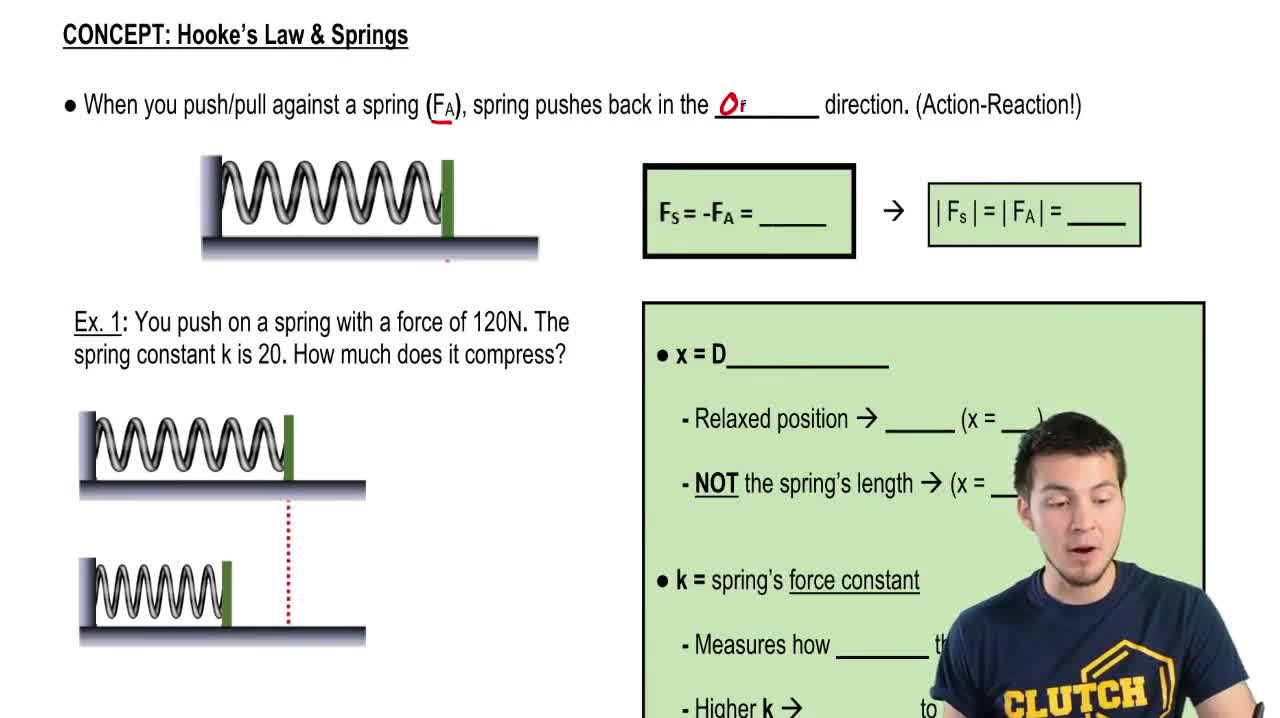
Hooke's Law states that the force exerted by a spring is directly proportional to the displacement from its equilibrium position, expressed as F = -kx, where F is the force, k is the spring constant, and x is the displacement. This principle is essential for understanding how the spring behaves when the block is displaced and how it influences the block's motion.
Recommended video:
Guided course
05:27
Spring Force (Hooke's Law)

Conservation of Energy

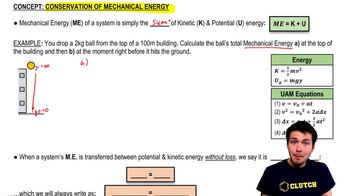
The principle of conservation of energy states that the total mechanical energy in a closed system remains constant if only conservative forces are acting. In this scenario, the potential energy stored in the spring and the kinetic energy of the block can be analyzed to determine the block's position and speed at different points in time.
Recommended video:
Guided course
06:24
Conservation Of Mechanical Energy

Simple Harmonic Motion (SHM)

Simple Harmonic Motion is a type of periodic motion where an object oscillates around an equilibrium position. The motion of the block attached to the spring can be modeled as SHM, characterized by a sinusoidal position and velocity over time, which is crucial for determining the block's distance from equilibrium at various speeds.
Recommended video:
Guided course
07:52
Simple Harmonic Motion of Pendulums
Related Practice
Textbook Question

A mass hanging from a spring oscillates with a period of 0.35 s. Suppose the mass and spring are swung in a horizontal circle, with the free end of the spring at the pivot. What rotation frequency, in rpm, will cause the spring's length to stretch by 15%?

1485
views
Textbook Question

Your lab instructor has asked you to measure a spring constant using a dynamic method—letting it oscillate—rather than a static method of stretching it. You and your lab partner suspend the spring from a hook, hang different masses on the lower end, and start them oscillating. One of you uses a meter stick to measure the amplitude, the other uses a stopwatch to time 10 oscillations. Your data are as follows: Use the best-fit line of an appropriate graph to determine the spring constant.

1980
views
1
comments
Textbook Question

Astronauts in space cannot weigh themselves by standing on a bathroom scale. Instead, they determine their mass by oscillating on a large spring. Suppose an astronaut attaches one end of a large spring to her belt and the other end to a hook on the wall of the space capsule. A fellow astronaut then pulls her away from the wall and releases her. The spring's length as a function of time is shown in FIGURE P15.46. What is her speed when the spring's length is 1.2 m?

1750
views
Textbook Question

A 500 g wood block on a frictionless table is attached to a horizontal spring. A 50 g dart is shot into the face of the block opposite the spring, where it sticks. Afterward, the spring oscillates with a period of 1.5 s and an amplitude of 20 cm. How fast was the dart moving when it hit the block?

1774
views
Textbook Question

A 200 g block hangs from a spring with spring constant 10 N/m. At t = 0 s the block is 20 cm below the equilibrium point and moving upward with a speed of 100 cm/s. What are the block's a. Oscillation frequency?

1029
views
Textbook Question

Scientists are measuring the properties of a newly discovered elastic material. They create a 1.5-m-long, 1.6-mm-diameter cord, attach an 850 g mass to the lower end, then pull the mass down 2.5 mm and release it. Their high-speed video camera records 36 oscillations in 2.0 s. What is Young's modulus of the material?

903
views