Ch 27: Current and Resistance
Knight Calc - Physics for Scientists and Engineers 5th Edition
Knight Calc5th EditionPhysics for Scientists and EngineersISBN: 9780137344796Not the one you use?Change textbook
Chapter 27, Problem 26b

A 1.5 V battery provides 0.50 A of current. How much work does the charge escalator do to lift 1.0 C of charge?

Verified step by step guidance
1
Understand the relationship between voltage, work, and charge. The work done by the battery on a charge is given by the formula: W = q V, where W is the work, q is the charge, and V is the voltage.
Identify the given values in the problem: the voltage of the battery is 1.5 V, and the charge to be lifted is 1.0 C.
Substitute the given values into the formula: W = 1.0 1.5.
Simplify the expression to calculate the work done. This will give the amount of energy (in joules) required to lift the charge.
Conclude that the work done by the charge escalator is directly proportional to the product of the charge and the voltage, as shown in the formula.

Verified video answer for a similar problem:

This video solution was recommended by our tutors as helpful for the problem above.
Video duration:
2m
Was this helpful?

Key Concepts

Here are the essential concepts you must grasp in order to answer the question correctly.

Voltage

Voltage, measured in volts (V), is the electric potential difference between two points in a circuit. It represents the energy per unit charge available to move charges through a circuit. In this question, the 1.5 V battery indicates that each coulomb of charge has 1.5 joules of energy available to do work.
Recommended video:
Guided course
07:14
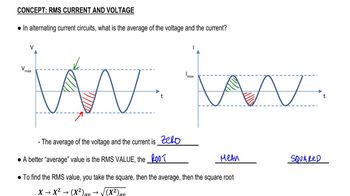
RMS Current and Voltage

Current

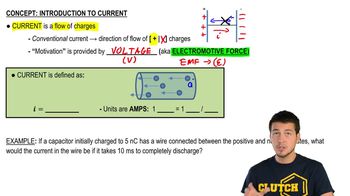
Current, measured in amperes (A), is the flow of electric charge in a circuit. It quantifies how much charge passes through a point in the circuit per unit time. In this scenario, a current of 0.50 A means that 0.50 coulombs of charge flow through the circuit every second, which is essential for calculating the work done on the charge.
Recommended video:
Guided course
05:38
Intro to Current

Work Done by Electric Charge

The work done by an electric charge when moving through a potential difference is calculated using the formula W = Q × V, where W is work in joules, Q is charge in coulombs, and V is voltage in volts. In this case, lifting 1.0 C of charge through a 1.5 V potential difference results in 1.5 joules of work done, illustrating the relationship between charge, voltage, and work.
Recommended video:
Guided course
05:37
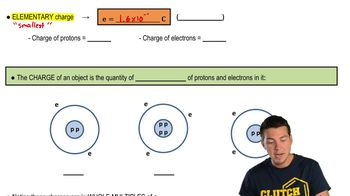
Electric Charge